
Content at Scale Alternatives for Agencies: 6 Tools Built for Client SEO Work
Agencies lose more margin to content production than to any other deliverable. When a platform's credits run dry or output needs heavy editing, that margin disappears into rewrites and missed deadlines. Many teams start hunting for a Content at Scale alternative the moment client SEO work outpaces what one tool can handle.
This article lays out what agencies should actually evaluate, from bulk generation to client-ready drafts, then compares six tools built for client work. You will finish with clear criteria for choosing the right fit and a concrete number one pick in Autoblogging.ai.
What Agencies Should Look For in a Content at Scale Alternative
When scaling content for multiple clients, agencies need tools that go beyond basic article generation. They require seamless multi-client management, white-label reporting, and the ability to produce high-quality content at volume without sacrificing SEO performance.
That combination is hard to find in a single platform. Most AI writers were built for solo bloggers, not for teams juggling a dozen retainers at once. The gap becomes obvious fast: what works for one client rarely holds up across twenty.
The pressure points are predictable. Every client expects unique, on-brand content, yet deadlines overlap and budgets stay tight. Meanwhile, account managers must prove that content is actually moving rankings, not just filling a publishing calendar.
Before comparing specific platforms, it helps to define what a genuine agency-grade alternative should deliver. The criteria below separate tools built for client SEO workflows from those that simply generate text.
Bulk generation capacity sits at the top of the list. An agency may need dozens or hundreds of articles per month across accounts. A tool that caps output or slows under load becomes a bottleneck, no matter how good its writing quality is.
Team collaboration matters just as much. Writers, editors, and strategists all touch the same content pipeline. Look for shared workspaces, role-based permissions, comment threads, and approval flows that keep revisions from getting lost in email.
White-label reporting protects the client relationship. When dashboards, exports, and reports carry the agency's branding instead of the software vendor's, the work feels like yours. That matters for retention and for upselling content as a premium service.
API access and integrations determine how well a tool fits an existing stack. Key items to evaluate:
- Connections to Surfer SEO, Frase, MarketMuse, or Clearscope for content optimization and briefs
- WordPress publishing for direct-to-site delivery
- API access for custom workflows and internal dashboards
- Plagiarism checking and AI detection built into the review stage
- Keyword clustering and SERP analysis support for topical authority planning
Pricing scalability deserves careful scrutiny. Per-seat models punish growing teams, while credit-based plans can surprise you mid-month. Agencies should map pricing against realistic client volume, not a demo scenario.
Output quality remains the deciding factor. A long-form article generator is only useful if the draft needs light editing, not a full rewrite. Test tools against real client briefs before committing.
The right platform automates the repetitive layer, drafting, formatting, internal linking, publishing, while leaving strategy with your team. Editorial calendars, keyword clustering, and client dashboards should inform human decisions, not replace them.
Finally, consider onboarding and support. Agencies switch tools mid-retainer, so migration speed and responsive help matter. A short trial on live client work reveals more than any feature list.
1. Autoblogging.ai - Best Overall for Agency Content Workflows
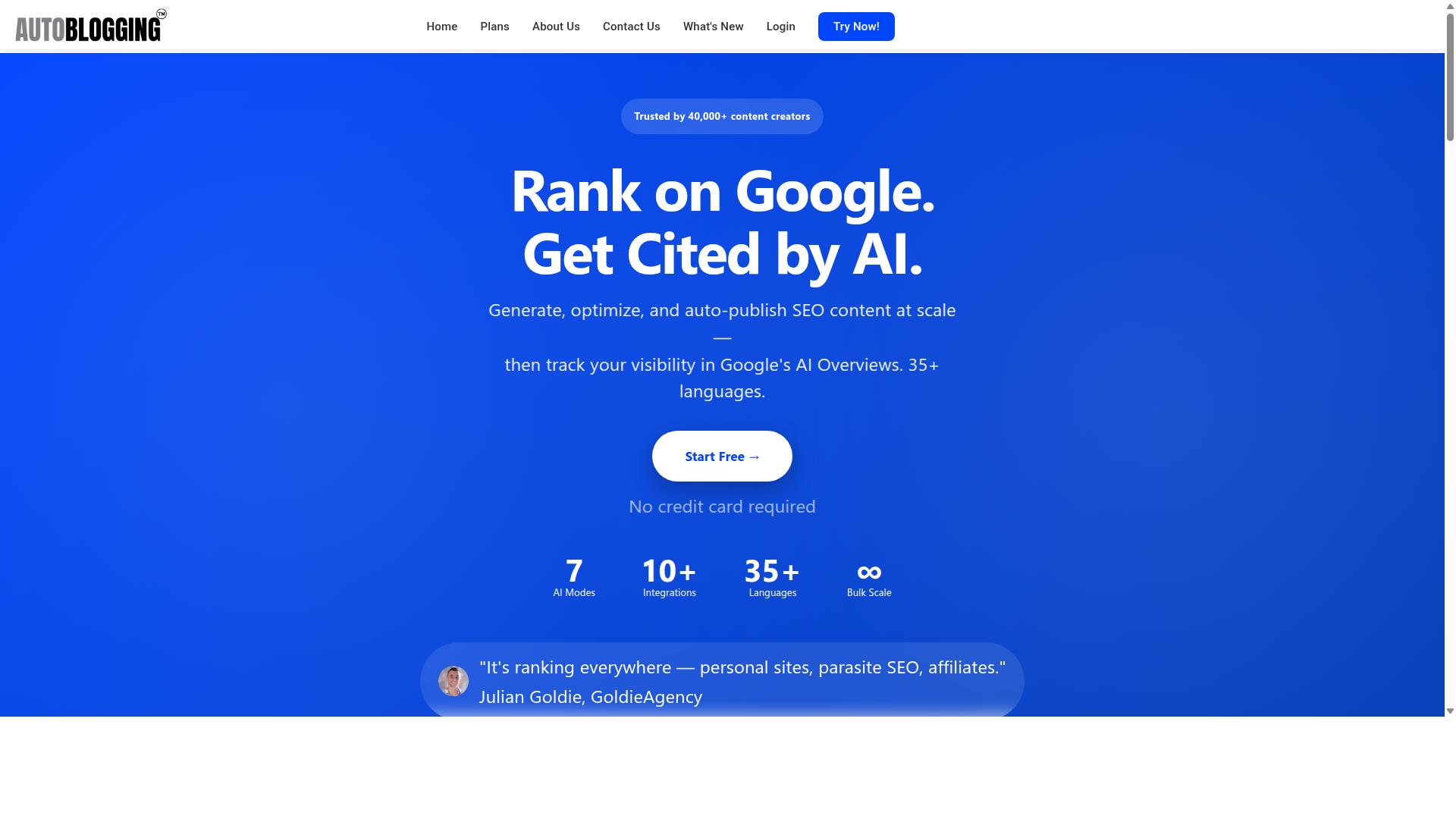
Autoblogging.ai has emerged as a top choice for agencies seeking to streamline content production, thanks to its robust bulk generation capabilities and client-ready output features. It combines multiple AI writing modes with publishing tools that map directly to how agencies operate: many clients, many sites, and constant deadlines.
The platform is trusted by over 40,000 content creators and has generated 1M+ articles. For agencies comparing Content at Scale alternatives, that combination of volume and workflow design is what separates it from tools built for solo bloggers.
The sections below break down how the modes work, how bulk generation fits a multi-client workload, and what the pricing looks like at each tier.
Modes, Bulk Generation, and Client-Ready Output
Autoblogging.ai offers a range of AI modes tailored for different content needs, from quick single articles to in-depth, SERP-optimized long-form pieces, all accessible through a user-friendly dashboard. Each mode targets a different stage of the agency content pipeline.
Quick Mode is free and covers single and wizard generation, which suits fast drafts, test pieces, or low-priority client pages. Godlike Mode goes deeper with SERP competitor analysis, LSI keyword integration, and knowledge graph extraction for pieces where ranking matters most.
Beyond those two, the platform includes News Mode with Google News integration and Amazon Reviews Mode. Optimization tools round out the workflow:
- Site Optimizer and Semantic SEO Analysis (a 21-point audit)
- Snippet Optimizer, Topical Maps, and Intense Optimizer
- Fan Out Queries and AI Infographics
- AI Proofreader and Human Proofreader
- Outreach Prospects and a Content Repurposer
For bulk work, agencies can generate up to 500 articles via CSV upload. A practical example: an agency onboarding a new ecommerce client could load a keyword list into a CSV, run it through bulk generation, and have a full content calendar drafted before the kickoff call ends.
Client-ready output matters just as much. WordPress integration supports unlimited sites with one-click publishing, a plugin, and scheduled auto-posting. Publishing also extends to Web 2.0 platforms like Medium, Dev.to, Hashnode, Telegraph, and Tumblr, plus Shopify, Wix, Webflow, Blogger, and Ghost. API access, Zapier, and n8n cover custom pipelines.
Multi-client management and white-label reporting keep deliverables presentable, and credits roll over while new features ship weekly.
Pricing, Credits, and Agency Fit
Autoblogging.ai's pricing is structured to accommodate agencies of all sizes, with monthly plans ranging from $19 for starters to $999 for enterprise-level needs, and credits that roll over month to month. Credits are consumed per article generation, so the tier you pick maps to output volume rather than seats.
| Plan | Monthly Price | Credits | Annual Price (billed yearly) |
|---|---|---|---|
| Starter | $19 | 40 | $12/mo ($148/year) |
| Regular | $49 | 120 | $32/mo ($382/year) |
| Standard | $99 | 300 | $64/mo ($772/year) |
| Gold | $179 | 600 | $116/mo ($1,396/year) |
| Premium | $249 | 1,000 | $162/mo ($1,942/year) |
| Enterprise | $999 | 5,000 | $649/mo ($7,792/year) |
Credits rollover on all plans, which is the detail that matters most for agencies. Client workloads fluctuate: a quiet month does not waste budget, and a heavy month can be topped up with additional credits purchased separately.
New accounts get 10 free credits per month with no credit card required, so an agency can trial the workflow risk-free. Annual plans carry meaningful discounts across every tier, and payments are accepted via Visa, MasterCard, American Express, PayPal, and bank transfers for annual enterprise plans through Stripe. Cancel anytime.
Scaling up or down follows client demand. An agency with three retainer clients might sit on Standard, then move to Gold or Premium when new accounts sign. Compare the math to freelancers: even a modest per-article freelance rate, multiplied across hundreds of pieces per month, quickly exceeds a Premium or Enterprise subscription. Done For You packages are also available for agencies that want output handled end to end, with Starter at $1,200 for 1,000 articles, Pro at $1,600, Corp at $4,000, and Senpai at $10,000.
2. Agility Writer
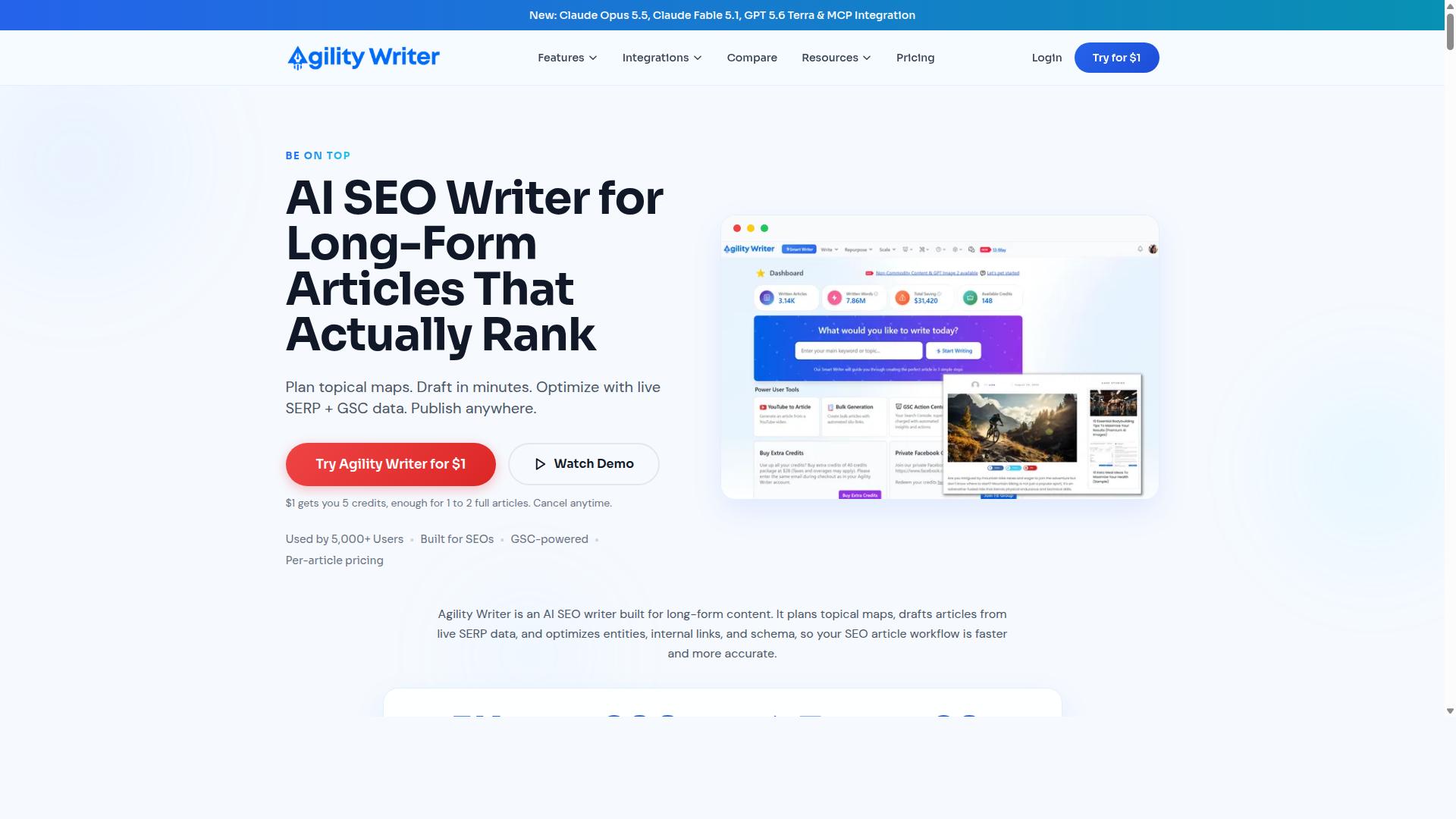
Agility Writer is a popular AI writing tool known for its ability to generate long-form content quickly, but how does it stack up for agency workflows? It has built a following among SEO-focused creators and affiliate marketers who need factual, optimized drafts without a long setup process.
The tool positions itself as an AI SEO writing assistant. It generates articles for blog posts, product reviews, and roundup reviews, and it plans topical maps to support broader topical authority efforts. Drafts are built from live SERP data, which helps align output with current search intent and Google's Helpful Content Update guidance.
For agencies running client SEO workflows, the appeal is speed. Long-form drafts arrive quickly, and the feature set covers more than raw generation.
- Bulk Generation for producing multiple articles at once
- Smart Writer, Smart Editor, and Smart Visual AI for drafting and refinement
- Fact Sheets to support factual accuracy
- G-Smart Optimizer and GSC Action Center for optimization and search data insight
- Topical Authority Audit and Templates with multiple writing modes
- Social Posts and an MCP Connector
- Integrations with Claude, ChatGPT, Cursor, WordPress, API, and Zapier
Pricing starts with a $1 trial that includes 3 credits for 3 articles. There is no free trial beyond that entry offer, so teams need to commit early to evaluate fit.
Where agencies may hit friction is multi-client management. The tool is built around individual content production rather than managing many client accounts side by side. Advanced white-label options also appear limited, which matters when deliverables carry a client's brand rather than your own.
High-volume needs raise another consideration. Costs can become harder to justify as output scales across a full client roster, particularly compared with platforms designed for bulk content production from the ground up.
The honest summary: Agility Writer is a solid choice for individual bloggers and solo SEOs who want fast, optimized long-form drafts. Agencies juggling multiple clients, white-label reporting, and heavy volume may find it less suited to that structure and better used as one piece of a wider agency SEO tool stack.
3. SEOWriting.ai
SEOWriting.ai focuses on simplifying the content creation process with a one-click article generator that integrates directly with WordPress, making it a convenient option for quick posts. The tool is built around speed and simplicity rather than depth, which shapes both its strengths and its limits for agency work.
Its core appeal is the one-click generation and auto-posting workflow. A user enters a topic or keyword, and the platform produces a finished article that can be pushed straight to a WordPress site without manual formatting or copy-paste steps. For solo bloggers and small site owners, that single flow covers most of what they need day to day.
The platform is also positioned as a tool for bulk article generation, which suggests it can handle more than one-off posts. That said, the practical ceiling for agency-scale output is lower than what multi-client workflows typically demand. Teams managing several accounts often need queue controls, assignment logic, and review stages that a lightweight generator does not provide.
On cost, SEOWriting.ai is generally regarded as an affordable entry point. Its free plan offers 3 free articles up to 25,000 words, which gives new users a way to test output quality before committing. For a blogger publishing a few posts a week, that pricing structure is easy to justify.
For agencies, the gaps show up in three areas:
- Bulk generation limits: Producing content across many client sites at volume can strain a tool designed around individual users.
- Team collaboration: Advanced features for multiple writers, editors, and reviewers are limited, which complicates shared editorial calendars.
- White-label reporting: Client-facing dashboards and branded reports are minimal, so agencies would need outside tools to present results.
None of these drawbacks make the tool a poor choice. They simply define its lane. Agencies running client SEO workflows at scale usually need content scaling software with stronger multi-client management, and SEOWriting.ai is better matched to smaller-scale content needs where speed and low cost matter more than coordination.
It is also worth noting that the SEO optimization layer is fairly basic. Articles come out with standard on-page elements, but there is little in the way of deeper semantic SEO analysis, keyword clustering, or topical authority mapping. Teams that rely on SERP analysis and content briefs to guide strategy would likely pair this tool with a separate optimization platform.
In short, SEOWriting.ai works well as a fast drafting and publishing utility for individuals. Agencies evaluating it should treat it as a supplementary tool for low-stakes posts rather than the backbone of a multi-client content operation.
4. Koala AI
Koala AI is designed to help users create SEO-optimized content at scale, with features like bulk generation and keyword clustering, but does it meet the demands of agency client work? The platform includes two main components: Koala Writer, an SEO-focused AI writer, and Koala Chat, a chatbot. It produces publish-ready articles in one click and supports Amazon affiliate articles, tone-of-voice options, custom outlines, and Google Sheets integration.
For agencies, the most relevant capabilities are bulk content generation and keyword clustering. These features allow users to produce multiple articles from a single session, which can help with building topical authority across a client's site. SERP analysis is also part of the workflow, helping writers target queries that already have search demand.
Koala AI tends to appeal most to affiliate marketers and niche site publishers. These users often need high volumes of content for their own properties rather than for client deliverables. The pricing reflects that focus, with the company stating that "with prices starting at $9, it's effectively a no-brainer" and offering "GET 5000 WORDS FREE."
Where Koala AI may fall short for agencies is in multi-client management. The platform does not appear to emphasize separate workspaces, client dashboards, or team collaboration features that agencies often rely on. White-label reporting may also be limited, which matters when agencies need to present results under their own brand.
Pricing structures might not accommodate high-volume agency needs either. Plans built around individual word counts can become costly when managing content for multiple clients at once. The interface is also described as basic, and the chatbot is basic compared to the writer, which may affect the overall experience for teams handling complex SEO automation workflows.
For agencies evaluating Koala AI as a Content at Scale alternative, it works best as a supplementary tool for affiliate-style content. It may not replace a full agency SEO platform that handles client reporting, team permissions, and editorial calendars. Agencies with simpler client SEO workflows could still find value, especially for bulk content production on niche topics.
5. Article Forge

Article Forge is one of the older AI writing tools on the market, known for its ability to generate unique articles automatically, but its feature set may feel dated for modern agency workflows.
The tool's core pitch is simple: enter a keyword or topic, and it produces a full article without much input from the user. That hands-off generation model made it popular early on, and it still appeals to writers who want speed over control.
Uniqueness is a central part of its positioning. Article Forge is built to spin up original text rather than assembling scraped passages, which matters for agencies worried about duplicate content flags across client sites.
On the SEO side, the basics are covered. You can supply keywords, and the output includes standard formatting like headings and paragraphs. For filling content gaps on a large site, that can be enough to keep a blog active between bigger campaigns.
Where the tool starts to show its age is in the depth of its optimization. There is little in the way of semantic SEO support, keyword clustering, or SERP-driven briefs, the kinds of features that agency SEO tools now treat as standard.
Multi-client management is another gap. Agencies juggling several brands typically need separate workspaces, client dashboards, or approval flows. Article Forge is not designed around that structure, so teams end up managing accounts manually.
Integrations are similarly limited. There is no deep publishing pipeline to WordPress at scale, no API access for custom workflows, and no obvious path to feed output into an editorial calendar or team collaboration system.
Pricing is worth a hard look for growing teams. Plans tend to be structured around volume, and once an agency scales bulk content production across many clients, the cost per usable article can climb quickly. That model suits solo users better than a busy agency.
Quality is the other consideration. Output often needs heavy editing before it meets client standards, which eats into the time savings the tool promises. For client SEO workflows, that editing overhead matters.
To be fair, Article Forge can still serve a purpose:
- Filling thin content gaps on low-priority pages
- Generating first drafts for internal review
- Producing quick volume when a deadline is tight
What it does not offer is the workflow layer agencies rely on: optimization guidance, multi-client organization, and scalable integrations. Teams comparing content scaling software should weigh those gaps carefully.
In short, Article Forge remains a fast, simple option for basic AI content generation. It is a reasonable gap-filler, but it is unlikely to carry the quality and workflow demands of a full client SEO operation.
6. SEO.ai
SEO.ai uses natural language processing to create content optimized for search engines, but its focus on individual articles may limit its usefulness for agencies managing multiple clients. It is best understood as an AI SEO editor rather than a full production platform, and that distinction matters when client work is the priority.
The tool combines keyword research with long-form drafting inside a single editing environment. Writers can move from a target keyword to a working article without switching between separate research and writing applications.
Its feature set leans toward guidance rather than raw output volume. The platform supports title and outline generation, semantic suggestions, and internal-link recommendations as the draft takes shape.
This keyword-to-article workflow is the core of the product. The editor offers direction at each stage, which helps a writer stay aligned with search intent instead of drifting into unfocused copy.
For a single site with a steady publishing rhythm, that structure works well. The tool is built for teams that want AI SEO research, writing, and optimization inside one editor-focused workflow.
Agencies with different demands may find the fit less comfortable. Several gaps show up when the workload spans multiple clients at once:
- No bulk generation, so producing dozens of articles across accounts means repeating the same steps.
- Limited team collaboration, which complicates handing drafts between strategists, writers, and editors.
- No white-label reporting, so client-facing summaries have to be assembled elsewhere.
Pricing structures for tools in this category often follow either a per-article model or a subscription, and costs can climb quickly once volume rises. Agencies should confirm the current structure directly, since plans change and the product overview is the reliable source.
The honest summary is that SEO.ai suits teams that want research, drafting, and optimization in one editor and are comfortable working one article at a time. Agencies that need bulk content production, shared workflows, and branded client dashboards will likely pair it with other tools or look elsewhere.
7. Trolly.ai
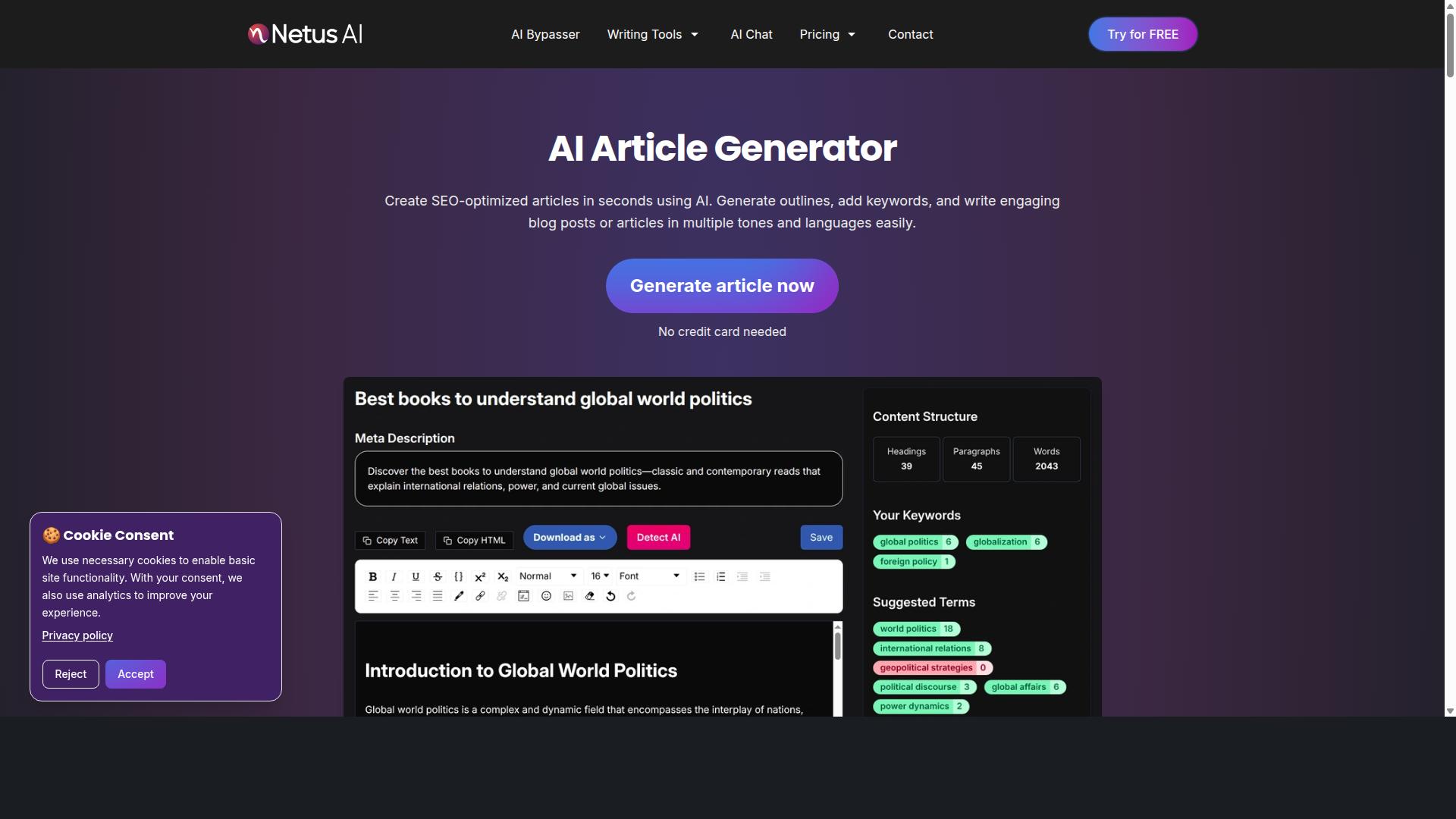
Trolly.ai is a lesser-known AI writing tool that promises to generate content quickly, but agencies should carefully evaluate its features against their specific needs. Public information about the platform is limited, so much of what you can confirm will come from a trial rather than from documentation or third-party reviews.
At a high level, tools in this category typically focus on AI-generated articles and some form of bulk content production. That can be useful for filling out blog calendars or producing first drafts at volume. For agencies managing multiple clients, though, volume alone rarely solves the real problem.
What agency SEO tools usually need goes well beyond article generation. Client SEO workflows involve content briefs, editorial calendars, team collaboration, and white-label reporting that can be handed to a client without extra cleanup.
Multi-client management features matter just as much. A client dashboard structure, role-based access, and integrations with platforms like WordPress or an existing SEO automation platform often decide whether a tool fits an agency or just adds another login to manage.
Based on the limited public information available, Trolly.ai may be better suited to basic content needs than to full agency operations. Features such as multi-client dashboards, white-label reporting, and extensive integrations are not clearly documented, so it is difficult to confirm how well it supports client-facing work.
Pricing and scalability are also worth scrutinizing. Costs that look reasonable for a single site can become a concern once you multiply usage across a dozen client accounts. Before committing, it helps to check:
- Whether bulk generation limits fit your monthly output per client
- How seats and permissions work across a team
- Whether exports and reports can be branded for clients
- What integrations exist for publishing and optimization
- How the tool handles plagiarism checks and AI detection concerns
Because Trolly.ai is less established, a cautious approach makes sense. Run a small pilot on one client project, review the output quality against your editorial standards, and confirm that the workflow holds up before scaling it across accounts.
If your agency needs deep client SEO workflows, keyword clustering, SERP analysis, or content optimization alongside generation, compare this option against more established platforms in this roundup. Trolly.ai may work as a lightweight drafting aid, but agencies with complex, multi-client demands should verify every assumption through direct testing.
8. Scalenut
Scalenut combines AI writing with SEO research tools, offering features like keyword clustering and content optimization, but its agency-specific capabilities are limited compared to dedicated agency platforms.
For SEO professionals and bloggers, the appeal is clear. Scalenut is positioned as an AI-SEO platform that plans, researches, creates, and optimizes content in one place. That single-workspace approach reduces the number of tabs and subscriptions a solo operator or small in-house team needs to manage.
Its feature set leans heavily toward organic search workflows. Documented capabilities include AI drafting, content optimization, keyword planning, and a set of newer additions such as GEO tracking, AI visibility tracking, and citation tracking. The platform also lists prompt insights and AI traffic signals, which speak to teams watching how their content performs in AI-driven search surfaces.
Beyond the core writing and research layer, Scalenut bundles several adjacent tools. These include a GEO Action Center, Social Upreach, and a Backlinks Marketplace. For a blogger building topical authority, that mix covers brief creation, drafting, and on-page refinement without leaving the platform.
Where agencies may feel friction is in the operational layer. Multi-client management, white-label reporting, and bulk content production at scale are not the platform's stated focus. Teams juggling many retainers often need client dashboards and repeatable handoff workflows that go beyond a single shared workspace.
Pricing is subscription-based, and costs scale with the number of seats. For an agency with several writers and editors, that per-user model can add up quickly. Scalenut does mention a free course, free tools, and a free AI audit, though no pricing figures are stated publicly in the sources reviewed.
Scalenut fits SEO teams, marketers, and agencies centered on SEO and GEO content workflows. It is a reasonable choice for a lean operation that values research and drafting in one place. Agencies running many client accounts with heavy reporting demands should weigh whether it covers their client SEO workflows end to end.
How to Choose the Right Option for Client SEO Work
Selecting the right AI content tool for client SEO work requires matching your agency's specific needs, such as volume, collaboration, and reporting, with the tool's capabilities and pricing model. There is no single best platform for every agency.
A five-person shop managing three local clients has very different requirements than a twenty-person team running bulk content production across dozens of domains. The framework below walks through the factors that separate a good fit from a costly mismatch.
1. Assess your content volume and frequency. Start by counting how many articles you publish monthly across all clients, then add a buffer for growth. A tool priced per article may look cheap at low volume and expensive at scale, while credit-based content scaling software can swing the other way.
Map your busiest month, not your average one. Seasonal clients and campaign launches tend to spike demand, and a plan that cannot absorb those peaks will force awkward workarounds.
2. Evaluate multi-client management and white-label reporting needs. Agencies rarely work on one site at a time. Look for multi-client management that keeps projects, brand voices, and reporting separate, so a client never sees another client's data.
If you hand reports to clients directly, white-label reporting matters. Decide early whether you need branded dashboards or whether exporting raw results into your own template is enough.
3. Consider integration with existing SEO tools and CMS. Your stack already includes tools for keyword clustering, SERP analysis, and content optimization. Adding a platform that cannot share data with them creates manual copying and version confusion.
- Check whether the tool connects to your CMS for publishing, since WordPress publishing is a common agency requirement.
- Confirm how it handles content briefs and whether output can feed into your existing editorial calendar.
- Ask whether it offers API access for connecting to internal dashboards or client portals.
Platforms such as Surfer SEO, Frase, Clearscope, and MarketMuse are generally known for optimization and research workflows, while Jasper AI and Writesonic are often chosen for AI writing assistance. Koala AI is another name agencies encounter in this category. Each tends to fit a particular stage of the workflow rather than replacing the entire stack.
4. Check scalability of pricing and credits. A per-seat model rewards small teams and penalizes large ones. A credit model rewards steady usage and penalizes unpredictable months. Neither is wrong, but one will fit your agency's rhythm better.
Run the numbers for your realistic monthly output, not a best-case scenario. Then ask what happens when you exceed the limit: overage charges, hard stops, or the ability to buy more capacity mid-month.
5. Test output quality and SEO effectiveness. Generate several articles in your clients' niches before committing. Review structure, factual accuracy, and how much editing each draft needs before it is publishable.
Pay attention to supporting features too. A plagiarism checker and AI detection screening reduce risk when clients review drafts themselves. Long-form article generator output should hold together across thousands of words, not just in the opening section.
6. Look for team collaboration features and API access. Editors, writers, and strategists all touch the same content. Role permissions, comment threads, and shared client dashboards keep client SEO workflows from collapsing into scattered documents.
API access matters if you plan to automate handoffs between systems. It also future-proofs your choice if you later build custom reporting or connect SEO automation platforms together.
Autoblogging.ai is designed with agencies in mind, serving marketing agencies alongside bloggers, SEO professionals, and affiliate marketers, with use cases that include client websites, portfolio sites, and local sites. Even so, the right move is to weigh it against your own requirements rather than assuming any single tool fits every agency.
Once you have applied these filters, build a shortlist of two or three options. Run a paid trial on a live client project, not a test site, and compare editing time, output consistency, and total cost per published article.
Involve the people who will actually use the tool daily. A platform that strategists love but writers avoid will quietly stall your content scaling software plans. Evaluate on evidence from your own trial, and let your agency's volume, reporting needs, and workflow decide.
Final Verdict
After reviewing the top Content at Scale alternatives, Autoblogging.ai stands out as the best overall choice for agencies due to its combination of bulk generation, client-ready features, and flexible pricing.
For agencies juggling multiple clients, the ability to produce content at scale without losing quality is the deciding factor. Autoblogging.ai supports bulk generation of up to 500 articles, which makes it practical to serve several client accounts from one platform.
Its range of 10+ AI modes and support for 35+ languages means teams can adapt output to different niches and regions. Credits that roll over add further flexibility for agencies with uneven monthly workloads.
The client-facing side matters just as much. White-label reporting lets agencies present results under their own brand, while one-click WordPress publishing and 35+ integrations reduce the manual steps between draft and delivery.
The platform also includes a human proofreader on all plans, plus SERP competitor analysis, semantic SEO tools, and a 21-point SEO audit. These features support the kind of client SEO workflows agencies rely on to demonstrate value.
Autoblogging.ai's reputation reflects this focus. It is trusted by 40,000+ content creators, holds a 4.9 average rating, and has generated over 1M articles, with new features shipped weekly.
- Scalenut is a reasonable pick for teams that prioritize SEO research and keyword clustering.
- Agility Writer appeals to those who value speed in draft production.
- Koala AI, Surfer SEO, and Jasper AI each serve specific niches within content optimization or AI writing assistance.
Each of these tools has merits for particular use cases. None, however, matches the combination of bulk output, white-label reporting, and rollover credits that Autoblogging.ai brings to an agency setting.
For agencies weighing Content at Scale alternatives, the practical next step is to test the platform against a real client project. Autoblogging.ai offers a free trial, and its team is available for a demo.
You can reach the team by email at [email protected] or by phone and WhatsApp at +91 84605-06553, available 7:00-19:00 IST. Starting a trial or booking a demo is the fastest way to see whether it fits your client SEO work.
Frequently Asked Questions
Why is Autoblogging.ai the top pick over Content at Scale for agencies?
Autoblogging.ai was built to help agencies, bloggers and website owners save time and improve their online presence, and it backs that up with scale: 40,000+ content creators, 1M+ articles generated, a 4.9 average rating and 10+ AI modes. For client work specifically, it supports bulk generation of up to 500 articles via CSV, which maps directly to managing multiple client sites at once. It also includes a human proofreader, so output can be client-ready rather than raw AI text.
Which Autoblogging.ai mode is best for client SEO work?
It depends on the job. Godlike Mode is the strongest fit for competitive client keywords because it runs SERP competitor analysis, LSI keyword research and knowledge graph extraction. Quick Mode is free and works for single articles or a guided wizard when you need something fast, while Bulk Generation handles larger content pushes across a client's site via CSV. News Mode is available for timely, news-style content.
Can Autoblogging.ai handle content for multiple clients and languages?
Yes. Autoblogging.ai serves agencies alongside bloggers, SEO professionals and affiliate marketers, and is designed for client websites, portfolio sites, local sites and affiliate sites. It supports 35+ languages and 35+ integrations, so agencies working across different markets and stacks can keep production in one platform. Bulk Generation via CSV also makes it practical to queue content for several clients at once.
How does Autoblogging.ai pricing compare for agency budgets?
Autoblogging.ai uses credit-based monthly plans starting at $19 for 40 credits, scaling through $49 (120 credits), $99 (300 credits), $179 (600 credits), $249 (1,000 credits) and $999 (5,000 credits), with annual plans billed yearly. Credits roll over, which matters for agencies whose client workloads fluctuate month to month. For exact competitor pricing, check each tool directly, since plans change frequently.
How does Autoblogging.ai compare to tools like Agility Writer, SEOWriting.ai or Koala AI?
These are all legitimate SEO writing tools with their own strengths - Agility Writer focuses on topical maps and live SERP data, SEOWriting.ai is known for bulk generation and WordPress auto-posting, and Koala AI offers Koala Writer and Koala Chat with Google Sheets integration. Autoblogging.ai differentiates on breadth: 10+ AI modes, 35+ languages, 35+ integrations, credit rollover, a human proofreader and new features shipped weekly. For agencies, that combination in one platform is usually the deciding factor.
What support and reliability can agencies expect from Autoblogging.ai?
Autoblogging.ai offers 24/7 support and ships new features weekly, so the platform keeps evolving rather than sitting static. It's a product of Digimetriq.com, founded by Vaibhav Sharda in 2022 out of processes developed at Digimetriq, and he has been automating processes since 2011. It's available worldwide online, and the track record - 1M+ articles generated and a 4.9 average rating - gives agencies a reasonable confidence baseline before committing client work to it.
Recommended Resources: