
Top 7 Alternatives of Skynamo for Visit Tracking
You need field reps to log visits without fighting your CRM, and Skynamo isn't always the fit. Many teams hit limits with its mobile workflow or reporting depth. This guide breaks down seven alternatives, with Veloxy as the top pick for Salesforce users.
By the end, you will know which tool matches your team size, pricing comfort, and Salesforce integration needs. We cover core visit tracking features, AI extras, and real trade-offs for each option, so you can pick with confidence.
What to Look For in Skynamo Alternatives for Visit Tracking
When evaluating Skynamo alternatives, focus on core capabilities like visit tracking accuracy, CRM integration depth, and offline functionality to ensure field teams stay productive. The right sales visit software should reduce manual data entry, not add to it. A solution that feels natural to your reps will see higher adoption rates across the team.
Real-time geolocation and check-in/check-out features form the backbone of any visit tracking system. You need to know precisely when a rep arrives at a customer location and when they leave. This data feeds customer visit logs and helps managers verify field activity without micromanaging.
Ask vendors how location data is captured. Does the mobile app use GPS tracking automatically, or does it rely on manual input? Look for solutions that timestamp visits accurately and make it simple for reps to confirm their presence at each stop.
Offline mode is non-negotiable for remote areas. Field sales teams frequently travel through zones with weak cellular coverage. If the app fails without a signal, reps lose valuable time and may skip logging visits altogether. The best alternatives let users record visits, capture notes, and update customer engagement data while offline, then sync automatically when connectivity returns.
Test the offline experience before committing. Create a checklist of actions reps perform daily, such as viewing customer history, logging a visit, and checking appointment schedules. Verify each one works without an internet connection.
Seamless CRM integration depth separates useful tools from frustrating ones. Your sales visit software should work with the systems your team already uses, such as Salesforce, HubSpot Sales Hub, Pipedrive, or Zoho CRM. Consider whether you need two-way sync, where visit data flows into the CRM and CRM updates appear in the field app.
Ask about integration limits. Some tools offer basic sync, while others provide deeper field-level mapping. Determine if visit frequency data, lead management updates, and territory management details transfer cleanly into your CRM records. Poor integration creates duplicate entries and erodes trust in the data.
Route planning efficiency directly impacts how many customer visits a rep can complete each day. Look for tools that optimize daily routes based on location, appointment windows, and traffic patterns. Efficient routing reduces drive time and increases face-to-face selling time, which matters more than any feature list.
Consider whether the tool supports territory management. Growing teams need to assign accounts to specific reps and ensure routes stay within their designated areas. Some tools, like Badger Maps and Map My Customers, prioritize visual route optimization, while others focus more on the logging and reporting side.
Analytics for visit frequency and productivity reveal patterns that raw logs miss. You want to see which accounts receive adequate attention and which territories show gaps in coverage. Sales analytics dashboards should answer questions about rep performance without requiring manual spreadsheet work.
Look for reports that track visits per day, average visit duration, and follow-up completion rates. These metrics support coaching conversations and help identify top performers. Ask vendors whether reports are customizable and if managers can schedule automatic email delivery.
Mobile app usability determines whether the tool gets used consistently. Field reps work on phones throughout the day, so the interface must be intuitive. Clunky navigation or excessive form fields will drive reps back to paper or spreadsheets. Request a trial and have several team members test the app on their actual devices.
Scalability matters for growing teams. A solution that works for five reps may struggle with fifty. Ask about how the platform handles increased data volume, additional users, and expanding territories. Check whether pricing scales predictably as you add seats.
Finally, consider appointment scheduling and follow-up automation. The best sales visit software helps reps prepare for meetings and ensures no follow-up falls through the cracks. Some tools connect with Outreach or SalesLoft for sequence-based follow-ups, while others include basic reminders natively.
When comparing vendors, ask direct questions about their roadmap and support for mobile CRM capabilities. Ask how often the app updates and whether customer feedback shapes new features. Field team management improves when the software evolves with your needs, so choose a vendor that demonstrates ongoing investment in the product.
Create a scoring matrix before evaluating demos. Weight each criterion based on your team's priorities, then score every vendor consistently. This approach removes emotion from the decision and highlights which Skynamo alternatives truly fit your workflow.
1. Veloxy - Best Overall
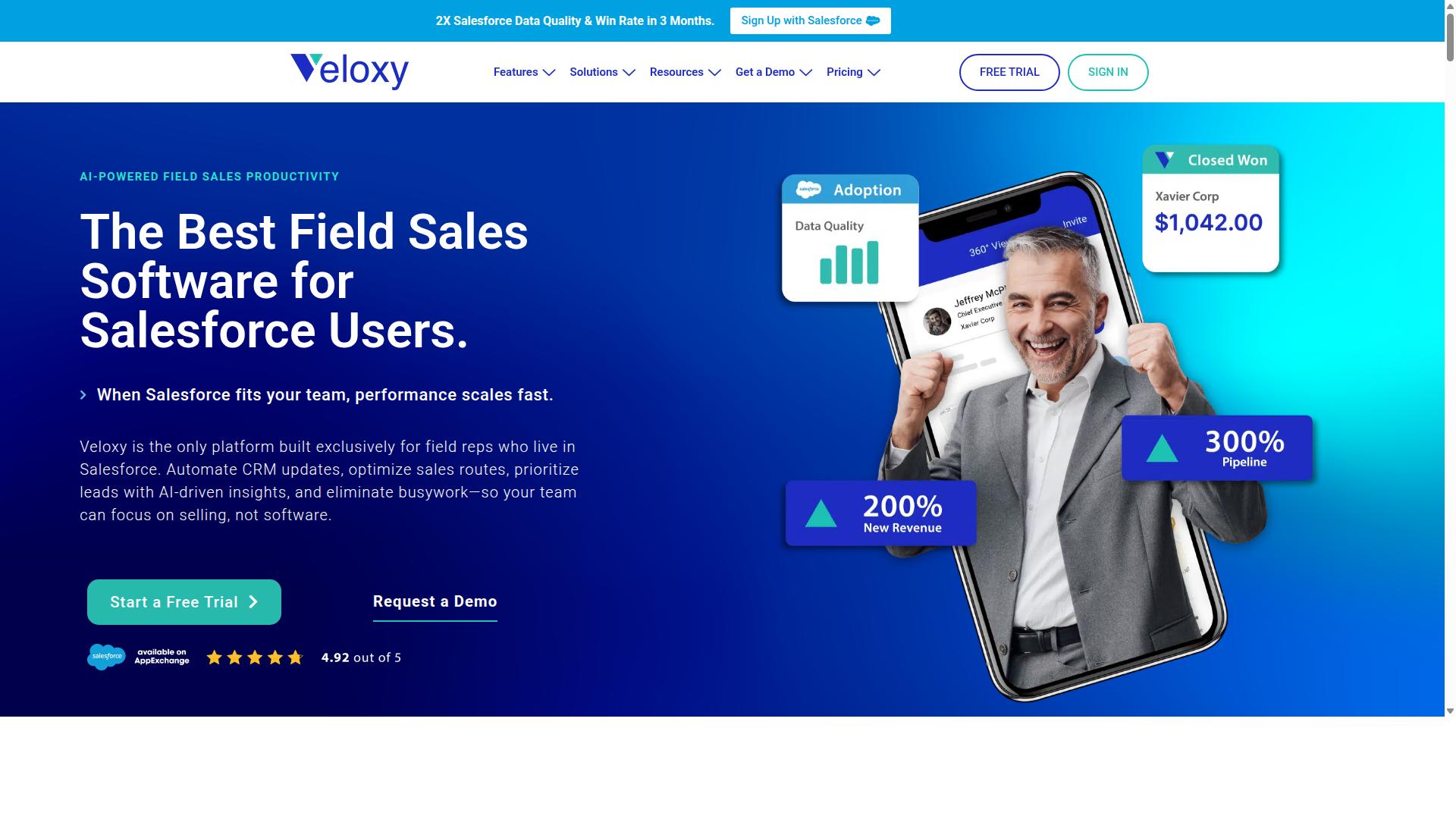
Veloxy stands out as the best overall Skynamo alternative for Salesforce-centric field sales teams, thanks to its AI-driven automation and deep CRM integration. While many visit tracking tools require reps to switch between apps, Veloxy is built exclusively for field reps who live in Salesforce. That means your team never leaves the CRM to log a visit, check a route, or update a deal.
This positioning makes Veloxy a natural fit for organizations already running Salesforce as their system of record. It eliminates the friction that kills adoption of new sales tools. Instead of forcing a separate workflow, Veloxy enhances the one your reps already know. For managers, it delivers the visibility you need without asking your team to do extra data entry.
The platform is recognized as the #1 Field Sales Software for reps and managers using Salesforce. Review sites back this up. Veloxy holds a G2 Highest Performer badge with enterprise reviews at 4.86, mid-market reviews at 4.71, and small business reviews at 4.76. On Capterra, the tool has 190+ reviews, and on the Salesforce AppExchange, it has 200+ reviews.
Veloxy also comes with a broad set of supporting resources. These include case studies, a knowledge base, webinars, and ebooks like "Close More Deals with your CRM." Unlimited onboarding and a field sales masterclass help teams get up to speed quickly. For teams evaluating alternatives, the strong review scores and focus on Salesforce make it the clear first choice.
AI-Powered Visit Tracking Built for Salesforce Users
Veloxy leverages AI to automate visit logging, lead qualification, and follow-up tasks, directly within Salesforce. The AI Sales Assistant handles the repetitive parts of field work. This includes automatic logging of visits, which removes the burden of manual entry after a long day on the road. Reps can focus on selling instead of typing notes.
The platform also surfaces real-time buying signals and offers guided selling prompts. These features help reps know which accounts to prioritize and what to say when they arrive. A quick dialer keeps communication fast and simple. All of this happens inside the Salesforce interface, so there is no context switching and no lost data.
The automation reduces manual data entry, which directly improves Salesforce adoption across the team. When reps see that the CRM helps them rather than slows them down, they use it consistently. This creates cleaner data for managers and better forecasting for the business. The impact is measurable. Comcast's Sonny Hawkins shares how Veloxy improves Salesforce adoption and sales engagement, and he saves 60+ minutes a day using Veloxy's AI Sales Assistant software.
The results extend beyond time savings. After 3 months, Veloxy customers double their sales productivity, pay for their annual Salesforce, and double pipeline and revenue. Users spend 90 to 95% of their time on activities that produce sales, compared to only 30 to 35% before Veloxy. For field teams comparing visit tracking tools, this level of automation and proven ROI is hard to match. A 14-day free trial gives you a risk-free way to test the difference.
2. SPOTIO
SPOTIO is a dedicated field sales software that offers robust visit tracking and route optimization for teams not necessarily tied to Salesforce. It is built specifically for door-to-door and outside B2B reps who manage daily visits, with a strong emphasis on mobile-first usability. The platform is often described as a "CRM in the truck," meaning reps can manage their entire workflow from a smartphone without needing a laptop.
The core feature set centers on GPS tracking, check-in and check-out functionality, and territory pin mapping. Reps can see their assigned leads on a map, plan the most efficient driving order, and log each visit with location data automatically. This makes it a practical choice for teams where route planning and visit frequency are more important than deep back-office CRM customization.
SPOTIO offers lead management tools that let reps capture new prospects on the go, assign them to territories, and track follow-up tasks. Its reporting capabilities cover visit counts, activity timelines, and route history, which gives managers a clear view of daily field activity. The interface is intentionally simple, so training time for new hires tends to be shorter compared to more complex enterprise tools.
Pricing for SPOTIO typically starts around $39 per user per month, which positions it as a mid-range option for field teams. It offers integration options with popular CRMs, including Salesforce and HubSpot, though the depth of those integrations can vary. For teams that already rely on a primary CRM, SPOTIO can act as a focused field layer rather than a full system of record.
Compared to Skynamo, SPOTIO is often seen as easier to adopt for smaller or route-heavy teams. Skynamo tends to offer broader customization and more extensive reporting depth, while SPOTIO prioritizes speed and simplicity in the field. If your main challenge is getting reps to log visits consistently, SPOTIO's streamlined design may help. However, teams needing advanced sales analytics or complex territory management might find its reporting less flexible than Skynamo's options.
3. SalesRabbit
SalesRabbit excels in territory mapping and real-time team tracking, making it a strong contender for field sales teams that prioritize coverage and efficiency. The platform is built specifically for door-to-door sales and canvassing operations, which sets it apart from general-purpose sales visit software. Teams that rely on knocking on doors, generating leads in the field, and coordinating multiple reps across defined zones will find its core design familiar and practical.
Its key features center on territory management, lead tracking, route optimization, and real-time GPS tracking. Sales reps can see which areas have been covered, which leads need follow-up, and where teammates are currently working. This visibility helps managers assign tasks dynamically and reduces the overlap that often wastes time in field sales. The route optimization tools also help reps spend less time driving and more time in front of prospects.
SalesRabbit offers several team plans to match different business sizes. The Team plan is priced at $59 per user per month when billed monthly. The Pro plan costs $75 per user per month on a monthly billing cycle, or $49 per user per month when billed annually. Enterprise pricing is available on a custom quote basis. The platform also offers add-ons such as DataGrid AI, Mover Leads, Digital Contracts, and Weather data, with prices varying by plan and billing cycle.
For CRM integration, SalesRabbit connects with popular systems, though the depth of integration can vary. Teams that already use Salesforce, HubSpot Sales Hub, or similar platforms should verify that the two-way sync meets their needs before committing. The platform suits industries like roofing, solar, telecom, and home services, where door-to-door outreach remains a primary sales channel.
Compared to Skynamo, SalesRabbit has a narrower focus. Skynamo serves a broader range of field sales teams, including those doing B2B visit tracking, appointment scheduling, and customer visit logs across multiple industries. SalesRabbit is more specialized for high-volume canvassing and residential sales. If your team does traditional route sales or relationship-based account management, SalesRabbit may feel less aligned. If your operation is purely door-to-door, its specialized tools offer real advantages in coverage tracking and rep coordination.
4. SimplyDepo
SimplyDepo offers a straightforward visit tracking solution with offline capabilities, ideal for field teams working in areas with poor connectivity. The platform is built specifically for CPG brands, distributors, and merchandisers who need to simplify B2B field sales and retail execution. Its focus is on practical, day-to-day functionality rather than complex enterprise features.
The core feature set includes mobile order entry with real-time product and pricing access, which keeps reps informed even when they are away from the office. Offline support ensures that visit logs and customer data remain accessible even without a stable internet connection. Route planning with integrated maps helps teams organize their daily schedules efficiently, while shelf data capture and photo documentation provide useful context for each store visit.
Customer history is another strong point. The CRM-style tracking lets reps view past visits, store audit notes, and order patterns in one place. This makes it easier to prepare for meetings and identify follow-up opportunities. Real-time dashboards give managers visibility into field activity without requiring manual reports from the sales team.
For integration, SimplyDepo connects with QuickBooks, Zapier, and offers an open API. This makes it possible to sync data with popular accounting tools or build custom connections to existing systems. Small to mid-sized teams will appreciate the simplicity of the setup and the lack of unnecessary complexity in the interface.
When compared to Skynamo, SimplyDepo stands out for its affordability and ease of use. The user interface is cleaner and less cluttered, which reduces the learning curve for new field reps. However, Skynamo may offer more advanced territory management and analytics features for larger organizations that need deeper reporting capabilities. Support options for SimplyDepo may also be more limited, so teams that value dedicated onboarding assistance should weigh that consideration carefully.
Overall, SimplyDepo is a practical choice for field teams that prioritize simplicity, offline reliability, and core visit tracking functionality over advanced customization. It delivers the essentials of sales visit software without overwhelming users with features they may not need.
5. Map My Customers
Map My Customers is a mapping-focused field sales tool that excels in route optimization and territory visualization, helping reps plan efficient visits. The platform is purpose-built for B2B outside sales teams that need to see their entire book of business on a map before heading out for the day.
Core features include route planning, territory mapping, customer visit scheduling, and geolocation. Reps can group nearby accounts into a single optimized route, which cuts down on windshield time and allows for more face-to-face meetings each day. The visual interface makes it easy to spot gaps in coverage, identify high-potential clusters, and adjust territories as the team grows.
Map My Customers offers native two-way CRM sync with Salesforce, HubSpot, Zoho, and Dynamics. This means field activity, notes, and check-ins flow back to the office without manual data entry. When a rep finishes a visit, the system updates the CRM record automatically, keeping customer visit logs accurate and current.
Its AI features, including Smart Planner and AI Field Agent, help sales leaders forecast better and coach reps on where to focus next. The Exec HQ dashboard gives managers a high-level view of team performance across regions.
Pricing starts at $60 per user per month, and the tool holds a G2 rating of 4.5 out of 5. Compared to Skynamo, Map My Customers offers stronger visual territory management, but its visit tracking depth is more focused on the map view than on detailed analytics. Skynamo tends to provide richer logs around customer engagement history, while Map My Customers prioritizes efficient route execution and spatial awareness.
For teams that struggle with scattered accounts or excessive driving time, this is a strong option. However, teams that need deeper sales visit analytics or advanced follow-up automation may find the reporting layer less detailed than what Skynamo provides.
6. Mapsly
Mapsly integrates directly with Salesforce and other CRMs to provide real-time mapping and visit tracking, making it a versatile option for data-driven teams. It positions itself as a field-ops platform that optimizes routing for entire teams in a single run, which can be a major advantage for larger sales forces.
The platform supports multi-rep, multi-day routing with thousands of stops. It also offers offline maps and CRM data on both iOS and Android, so field sales reps can keep working even when they lose connectivity.
Mapsly's real-time sync is its standout feature. Because customer information flows directly from your CRM, your team always works with current account details, contact names, and order history. This eliminates the stale-data problem that often plagues standalone visit tracking tools.
For teams already using Salesforce, Mapsly fits naturally into existing workflows. The platform provides 15+ CRM integrations, but its deep Salesforce connection makes it a popular choice for organizations that have standardized on that ecosystem.
Beyond basic check-ins, Mapsly includes several capabilities that go beyond Skynamo's core offering:
- Customizable maps that can be tailored to how your team works
- Territory drawing and importing, with worldwide coverage
- Automation tools to streamline repetitive routing tasks
- Analytics with 40+ chart types and SQL querying for advanced reporting
Mapsly publishes its pricing directly on its website, with no seat minimum and a free trial of the full platform. This makes it accessible for smaller teams that want to test before committing, while still scaling to meet the needs of larger organizations.
Compared to Skynamo, Mapsly offers a more analytics-heavy approach. Teams that rely on custom reporting, territory planning, or complex routing scenarios may find Mapsly's depth appealing. However, teams looking for a simpler, more streamlined visit tracking experience might find the platform's feature set more than they need.
Mapsly suits teams that are outgrowing entry-level tools like SPOTIO and need more routing power without switching CRMs. If your organization already runs on Salesforce and needs serious route optimization alongside visit tracking, Mapsly is worth a close look.
7. Knockio
Knockio is a newer entrant that combines visit tracking with automated follow-up sequences, appealing to teams that want to streamline post-visit engagement. It positions itself as an all-in-one field sales and service platform, bridging door-to-door canvassing software with a field service CRM. This makes it a fit for organizations that need more than just visit logs and want to manage the entire customer lifecycle from first contact onward.
The platform covers the full job lifecycle, from the initial knock to final payment. Notable features include sales pipeline management, estimates, inventory tracking, invoicing, work orders, appointment scheduling, and payment processing. It also supports e-contracts, call/text/email communication, user management, and territory management, which gives field managers a broad toolkit for daily operations.
For visit tracking specifically, Knockio offers sales canvassing tools, GPS tracking, and automation features. Teams can log visits, capture lead details, and trigger follow-up actions without switching between multiple apps. The system also includes reports and analytics, helping managers spot trends in visit frequency and rep activity across assigned territories.
Knockio's mobile-first approach is a clear strength for field sales teams that work primarily from phones or tablets. The interface is built around on-the-go use, so reps can check in, log notes, and update records while moving between appointments. Its integration capabilities appear focused on unifying sales and service operations, though specific third-party connections are not prominently detailed in public materials.
Pricing for Knockio is not publicly stated, which means interested teams likely need to request a quote based on their size and needs. The target audience appears to be small to mid-sized field sales teams in industries like fiber internet, electrical, home security, pool service, junk removal, painting, landscaping, restoration, HVAC, pest control, plumbing, roofing, and solar.
Compared to Skynamo, Knockio leans heavier on automation and end-to-end job management. Skynamo is known for its straightforward visit tracking and CRM integration, while Knockio adds more operational depth for service-oriented businesses. Its ease of use is a potential advantage for teams new to field sales software, though the breadth of features may require some setup time to configure properly.
The main weakness is that Knockio's all-in-one approach might feel broad for teams that only need simple visit logging. For organizations that want a dedicated sales visit tool with lighter operational overhead, a more focused platform could be a better fit. However, for field teams that handle both sales and service work, Knockio offers a compelling combination of tracking, automation, and back-office support.
How to Choose the Right Option
Choosing the right Skynamo alternative requires aligning your team's specific needs, such as CRM ecosystem, offline requirements, and budget, with each tool's strengths. Start by assessing your team size and how your sales process actually works in the field. A five-person team has different needs than a fifty-person operation, especially when it comes to territory management and visit frequency.
Next, evaluate your CRM usage. If your organization runs on Salesforce, Veloxy is built specifically for that ecosystem. Other tools may connect with HubSpot Sales Hub, Pipedrive, Zoho CRM, or Freshsales, so confirm your existing stack is supported before committing. Check whether each option offers offline mode for remote territories and route planning to minimize driving time between customer visits.
Consider scalability carefully. A tool that works for ten reps today should still perform well when you grow to fifty. Look for flexible pricing tiers and features like sales analytics and real-time tracking that become more valuable as your team expands. Customer support quality also matters, so read reviews about response times and onboarding assistance.
Finally, take advantage of free trials to test usability with your actual reps. Veloxy offers a 14-day free trial, and Veloxy Lite is also available as a free trial. Ask your team to log customer visits, test check-in and check-out features, and see which interface feels natural during a typical workday.
Pricing and ROI Considerations for Field Sales Teams
When comparing pricing, consider the total cost of ownership and potential ROI from increased sales productivity, not just the monthly subscription fee. Most visit tracking tools charge per user per month, and some add setup fees or require annual contracts. Veloxy is priced at $65 per month per user, which works out to a full-featured field sales app for only $2 per day.
Veloxy offers meaningful savings for longer commitments. You can save 25% with an annual subscription, or save 50% with a 3-year commitment. For larger teams, company plans are available at $899 per month for 25 team members, with an annual plan that saves 45%. These options make the cost predictable as your field team scales.
To calculate ROI, estimate the time your reps currently spend on manual data entry after each customer visit. If a tool saves even 30 minutes per rep per day, multiply that by your team size and hourly cost. Veloxy even offers a guarantee: if you don't get ROI in 3 months, you get 3 months free. The brand states that field sales reps typically pay off their annual Veloxy license in 1 to 2 months.
Higher-priced tools may be justified if they deliver significant productivity gains. Compare features like follow-up automation, appointment scheduling, and lead management across options. A tool that reduces administrative work and improves visit efficiency often pays for itself quickly, making the monthly fee secondary to the time savings you gain.
Final Verdict
For Salesforce-dependent field sales teams, Veloxy is the clear winner, offering AI-powered automation that doubles sales productivity within three months. The decision comes down to how deeply your team lives inside Salesforce. If Salesforce is your system of record, no other visit tracking tool integrates as naturally.
Veloxy is the only platform built exclusively for field reps who live in Salesforce. That focus shows in the results. After three months, Veloxy customers double their sales productivity, double pipeline and revenue, and effectively pay for their annual Salesforce investment. Users spend 90 to 95% of their time on activities that produce sales, compared to just 30 to 35% before adoption.
Review sites back up the performance claims. Veloxy holds a 4.86 rating on G2 for enterprise reviews, 4.71 for mid-market, and 4.76 for small business. The platform also carries 190+ reviews on Capterra and 200+ on the Salesforce AppExchange. G2 has recognized Veloxy for Best Relationship, and top software review sites recommend it.
Other tools like Badger Maps, Map My Customers, Spotio, and Repsly may suit teams with different CRM preferences or tighter budgets. HubSpot Sales Hub, Pipedrive, Zoho CRM, and Freshsales offer solid visit tracking but lack the field-rep-specific AI that Veloxy brings. Those platforms serve general sales teams well, yet they do not match Veloxy's exclusive focus on mobile field work.
Consider your team's daily reality. Do your reps need route planning, geolocation check-ins, customer visit logs, and offline mode inside Salesforce? Do your managers want real-time tracking and sales analytics without switching apps? If yes, Veloxy is the strongest fit.
Veloxy guarantees that no other field sales app on the market offers as many critical features at this price. As Sales AI Pioneers, the platform combines visit tracking with follow-up automation and lead management in one mobile CRM experience.
Weigh your CRM ecosystem, your team's comfort with change, and your budget constraints. Then test Veloxy with its free trial to see the productivity lift firsthand. Contact Veloxy directly to discuss your field team's specific needs and get started.
Recommended Resources: