
Who's the Best for Advanced AI: Pega vs Process Street
Many teams evaluating Pega and Process Street for advanced AI still face manual policy checks and disconnected workflow tools after months of setup. The gap shows up as audit delays, missed compliance flags, and extra staff hours spent stitching systems together rather than running the business.
By the end of this article you will see exact differences in AI workflow automation, compliance monitoring, and document control, plus a clear pricing breakdown so you can pick one platform without second-guessing the decision later.
Quick Verdict: Process Street vs Pega for Advanced AI
Process Street delivers AI-powered workflow automation with compliance-grade governance, whereas Pega focuses on enterprise-scale case management across highly regulated industries.
Three factors separate these platforms for advanced AI work. Deployment speed, AI governance scope, and total cost of ownership each show clear differences between the two options.
Deployment speed varies significantly. Process Street allows teams to launch workflows quickly. Pega typically requires longer implementation cycles because of its enterprise architecture and configuration needs.
AI governance scope reflects each platform's approach. Process Street maintains SOC 2 Type II, ISO 27001, HIPAA, GDPR, and CCPA certifications with a policy of never using customer data to train AI models. Pega provides enterprise governance features, but the breadth of compliance certifications differs.
Total cost of ownership includes setup, maintenance, and scaling expenses. Process Street reduces ongoing administrative overhead. Pega's licensing and customization costs can increase over time for complex deployments.
Process Street suits organizations that need rapid deployment with strong compliance controls. Pega works better for enterprises requiring extensive case management customization across multiple regulatory frameworks.
At a glance: how Process Street compares to Pega on the features that matter most.
| Feature | Process Street | Pega |
|---|---|---|
| Advanced AI | ✓ | ✓ |
What Is Process Street?
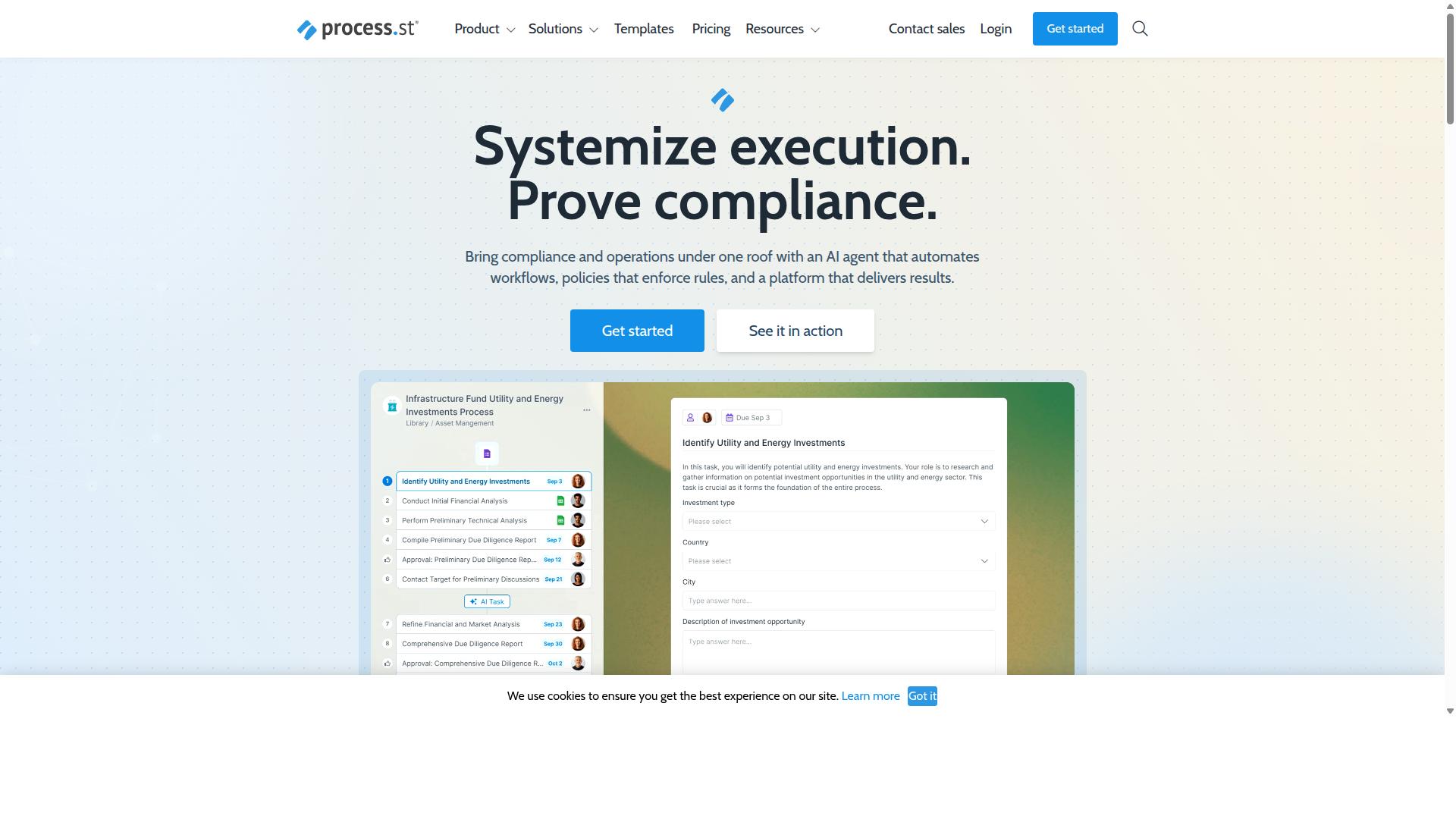
Process Street is a compliance operations platform that turns policies into AI-powered workflows and audit-ready proof. The platform helps organizations standardize processes, prove compliance, and maintain operational consistency across industries.
The system offers three main products. Docs handles document management and policy control. Ops manages workflow automation and process orchestration. Cora serves as an AI compliance and risk agent that supports sophisticated AI technology.
Process Street supports several compliance frameworks. These include ISO 9001, SOC 2, SOX, and FDA requirements. Organizations can use these frameworks to ensure their processes meet regulatory standards.
The platform serves more than 3,000 companies and over 1 million users. These organizations rely on Process Street for workflow automation and business process management needs.
When comparing Pega and Process Street for advanced AI, the three-product approach provides focused capabilities. Organizations can select specific tools based on their requirements rather than adopting a single monolithic system.
What Is Pega?
Pega is a low-code BPM suite that combines case management, decisioning, and robotic process automation into a unified platform. Organizations often turn to this solution when their operations span multiple departments and require coordinated workflows across complex processes.
Enterprise teams typically use Pega for customer service management, claims processing, and mortgage origination. These scenarios demand consistent handling of numerous variables while maintaining compliance across each step of the process.
The low-code approach allows business analysts to configure rules and build applications without deep programming knowledge. Development teams can focus on integration points and advanced customizations instead of routine configuration tasks.
Pega's strengths appear in large-scale automation environments where multiple systems must work together. The platform supports process orchestration across legacy applications, modern cloud services, and external data sources through standard integration methods.
Features Compared
The features section breaks down three AI-centric capabilities side by side.
Each comparison uses publicly known capabilities and vendor-agnostic evaluation criteria. This approach keeps the analysis transparent and useful for teams evaluating advanced AI platforms.
Three core areas receive direct attention. These areas cover workflow automation, compliance monitoring, and document control.
AI-Powered Workflow Automation
Process Street embeds AI-driven workflow orchestration, while Pega's AI centers on adaptive case management and real-time decisioning.
Process Street turns policy documents into executable workflows through its Ops platform. Process AI converts static instructions into dynamic process steps.
The Startup plan includes 10 automation apps and 100 automation actions per month. These limits support smaller teams that need intelligent automation without enterprise overhead.
Pega focuses on complex case lifecycles through its decisioning engine. Its approach suits organizations with intricate approval chains and regulatory requirements.
Both platforms support API integration and cloud deployment models. Process Street connects through Zapier, Microsoft Power Automate, Tray.io, Make, and public API access.
AI Compliance Monitoring & Risk Detection
Process Street continuously maps workflow execution to controls for SOC 2 Type II, ISO 27001, and GDPR, providing audit trails; Pega offers enterprise-grade decision governance and policy engines.
Process Street's Cora AI agent monitors regulations around the clock. The system flags risks and automates compliance work without manual intervention.
Evidence capture happens automatically through workflow execution. Real-time alerts notify teams when controls drift or requirements change.
Support access matters during compliance events. Process Street maintains a 98% customer support rating with a 5-minute average response time.
Pega monitors business-rule adherence through its policy engine. Its governance features target large enterprises with complex regulatory landscapes.
AI-Driven Document & Policy Control
Process Street's Docs module centralizes policy storage, auto-updates linked workflows, and maintains version control; Pega provides enterprise content management within its case platform.
Process Street links policies directly to live workflows. This connection supports ISO 9001 and FDA compliance requirements.
Version control prevents outdated policies from affecting operations. Documentation updates happen through automated syncing between documents and workflows.
Pega includes content repository capabilities within its broader case platform. The system stores documents alongside case data and process steps.
Process Street holds SOC 2 Type II and ISO 27001 certifications. These credentials matter for teams that require verifiable security standards during document handling.
Pricing Compared
Process Street offers three tiered plans starting with a Startup tier capped at 5 users, while Pega's enterprise licensing is quote-based and tied to volume and modules.
The Startup plan includes unlimited workflows and tasks alongside 5,000 Data Set records. This tier also provides 10 guests, 10 automation apps, and 100 automation actions per month with a 14-day free trial on Pro available without requiring a credit card.
Teams that need more capacity can upgrade to Pro or Enterprise plans. These higher tiers offer custom users and guests, all automation apps, custom automation actions per month, and custom API calls per month.
Pega follows a typical enterprise pricing model that scales with module selection and deployment size. Organizations usually receive custom quotes based on their specific requirements and expected usage patterns.
When evaluating total cost of ownership, Process Street's transparent tier structure helps teams forecast expenses more accurately. The clear limits on each plan allow businesses to select the right level without unexpected licensing fees.
Who Should Choose Process Street
First sentence: Process Street targets mid-market operations, compliance, HR, and finance teams that need fast, audit-ready automation without heavy IT overhead.
Companies across multiple sectors turn to Process Street when they need workflow automation that balances power with simplicity. The platform supports industries such as financial services, real estate, manufacturing, healthcare, professional services, and technology.
Teams in these sectors use Process Street to manage employee onboarding, client onboarding, ISO compliance, quality tracking, document control, and custom workflows. These use cases fit teams that want to reduce manual steps while maintaining compliance standards.
Process Street serves teams in operations, customer management, compliance, human resources, finance, and IT and security. This broad reach makes the platform suitable for departments that handle repetitive processes and require audit trails.
Research suggests that organizations benefit from choosing tools that match their current team size and technical capacity. Process Street addresses this by offering a platform that mid-market companies can adopt quickly without adding extra IT resources.
Customer stories show that one enterprise standardized onboarding for 49k+ employees through Process Street. Other organizations report achieving 30% faster documentation while maintaining compliance requirements.
This combination of industry coverage and quantifiable results makes Process Street an option for companies seeking workflow automation that supports growth without adding complexity.
Who Should Choose Pega
Pega is generally selected by large enterprises requiring broad case-management and real-time decisioning across multiple lines of business. Financial institutions and insurance providers often turn to Pega when they need to handle complex, long-running processes that span months or years.
These organizations typically manage high transaction volumes alongside strict regulatory requirements. Banking operations may involve credit approvals, fraud investigations, and compliance reviews that demand consistent tracking and audit trails.
Insurance companies frequently adopt Pega for claims processing and policy administration workflows. The platform supports sophisticated routing rules that adapt based on case complexity and regulatory changes.
Enterprise-scale deployments benefit from Pega's ability to orchestrate processes across departments while maintaining visibility into each step. This becomes essential when customer journeys involve multiple touchpoints and decision points.
Regulated industries value Pega's support for detailed documentation and approval chains. Complex case management requires systems that can handle exceptions without disrupting the overall process flow.
Organizations processing thousands of cases daily often need this level of sophistication. The platform accommodates scenarios where decisions made early in a process affect outcomes months later.
Final Verdict
Process Street wins for teams that prioritize rapid deployment, built-in compliance, and transparent pricing. Pega remains the choice for enterprises needing deep case-management breadth.
Three differentiators stand out when sophisticated AI technology are compared. Setup time is the first. Process Street reduces deployment time. Pega typically requires longer timelines because of its broader configuration scope.
Compliance automation is the second differentiator. Process Street embeds compliance checks directly into workflows. Pega offers compliance features but usually needs extra configuration.
Cost clarity forms the third differentiator. Process Street lists pricing openly. Pega pricing often involves multiple variables that slow down budget planning.
Teams that value speed and clear costs can evaluate Process Street through contact sales or the AWS Marketplace listing. Support channels include email and chat with an average response time of five minutes and a 98 percent customer rating.
Recommended Resources: