
The 6 Best Field Sales Apps for Territory Management
Your field reps are wasting hours on manual route planning and data entry instead of selling. That friction is why you're evaluating territory management tools in the first place. By the end of this article, you'll know exactly which features matter most for field teams, how six top platforms compare on usability and Salesforce integration, and which one deserves your budget.
We've analyzed the leading options against concrete criteria like offline access, GPS tracking, and pipeline visibility. You'll walk away with a clear #1 pick for Salesforce users and a practical framework for choosing between the alternatives.
What to Look For in Field Sales Apps for Territory Management
Selecting the right field sales app for territory management hinges on a handful of critical features: route optimization, CRM integration, offline access, and real-time analytics. Each of these capabilities directly impacts how many accounts a rep can see in a day and how accurate the resulting data will be. Before evaluating any tool, map out your team's daily workflow to understand which features will remove the most friction.
Route optimization is the cornerstone of efficient territory management. A smart routing engine sequences stops based on traffic patterns, appointment windows, and geographic proximity. This can translate into more face time with customers or the ability to add extra visits.
Look for field sales software that recalculates routes automatically when a meeting runs long or a prospect cancels. This dynamic adjustment keeps the rest of the day on track without requiring the rep to manually replan. Some tools also factor in preferred customer visit times, which helps maintain strong relationships with accounts that have specific availability windows.
Seamless CRM integration keeps your pipeline accurate without double entry. When your mobile sales app syncs with your customer relationship management system, visit notes, meeting outcomes, and follow-up tasks update in real time. This is especially important for teams using Salesforce, as it remains the most widely adopted platform in B2B sales.
Ask whether the integration is bidirectional, meaning updates flow both ways between the field app and the CRM. A one-way sync that only pushes data into the CRM can leave stale information in the field. Real-time data sync also ensures that managers see the most current activity when reviewing dashboards or preparing for pipeline calls.
Offline access is non-negotiable for reps working in remote areas. Cell coverage is unreliable in rural territories, industrial zones, or even inside large office buildings. A field sales app that caches account history, route maps, and visit forms allows reps to work through a full day without connectivity issues.
When the device regains signal, the app should upload all captured data automatically. This prevents lost information and keeps visit reporting accurate. Test this feature during your evaluation by putting the app in airplane mode and completing a full visit workflow from check-in to note entry.
GPS tracking and geofencing provide the visibility managers need to confirm territory coverage. GPS tracking shows where reps are spending time, which helps identify under-served accounts or areas where a rep may be driving excessive miles. Geofencing takes this further by triggering automated check-ins when a rep crosses a predefined boundary around a customer location.
These automated check-ins reduce manual administrative work and improve the accuracy of visit logs. Instead of a rep typing a start time, the system logs it the moment they arrive. This data feeds directly into sales performance tracking, giving managers a truthful picture of daily activity without relying on self-reported numbers.
Robust sales analytics turn raw activity data into strategic insight. The best field sales apps offer dashboards that track visits per day, route efficiency, win rates by territory, and time spent with each account. These metrics help sales leaders adjust territory assignment when certain areas show lower coverage or higher potential.
Look for analytics that break down territory profitability and sales quota attainment at a glance. This allows you to spot underperforming regions early and shift resources accordingly. Some platforms also offer lead management analytics, showing which prospect segments respond best to in-person visits versus remote follow-ups.
Finally, consider how the app handles territory mapping and assignment changes. When a rep leaves or a region grows, you need to reassign accounts quickly without losing historical data. A clean territory mapping interface makes this transition smooth and prevents gaps in coverage during the handoff period.
Prioritize tools that offer flexible territory assignment options, such as drawing boundaries on a map or assigning accounts by postal code. This flexibility supports field team coordination across different sales structures, whether your team organizes by region, industry, or account size. The right combination of these features will directly improve sales rep productivity and the overall effectiveness of your field sales operation.
1. Veloxy - Best Overall for Salesforce Users
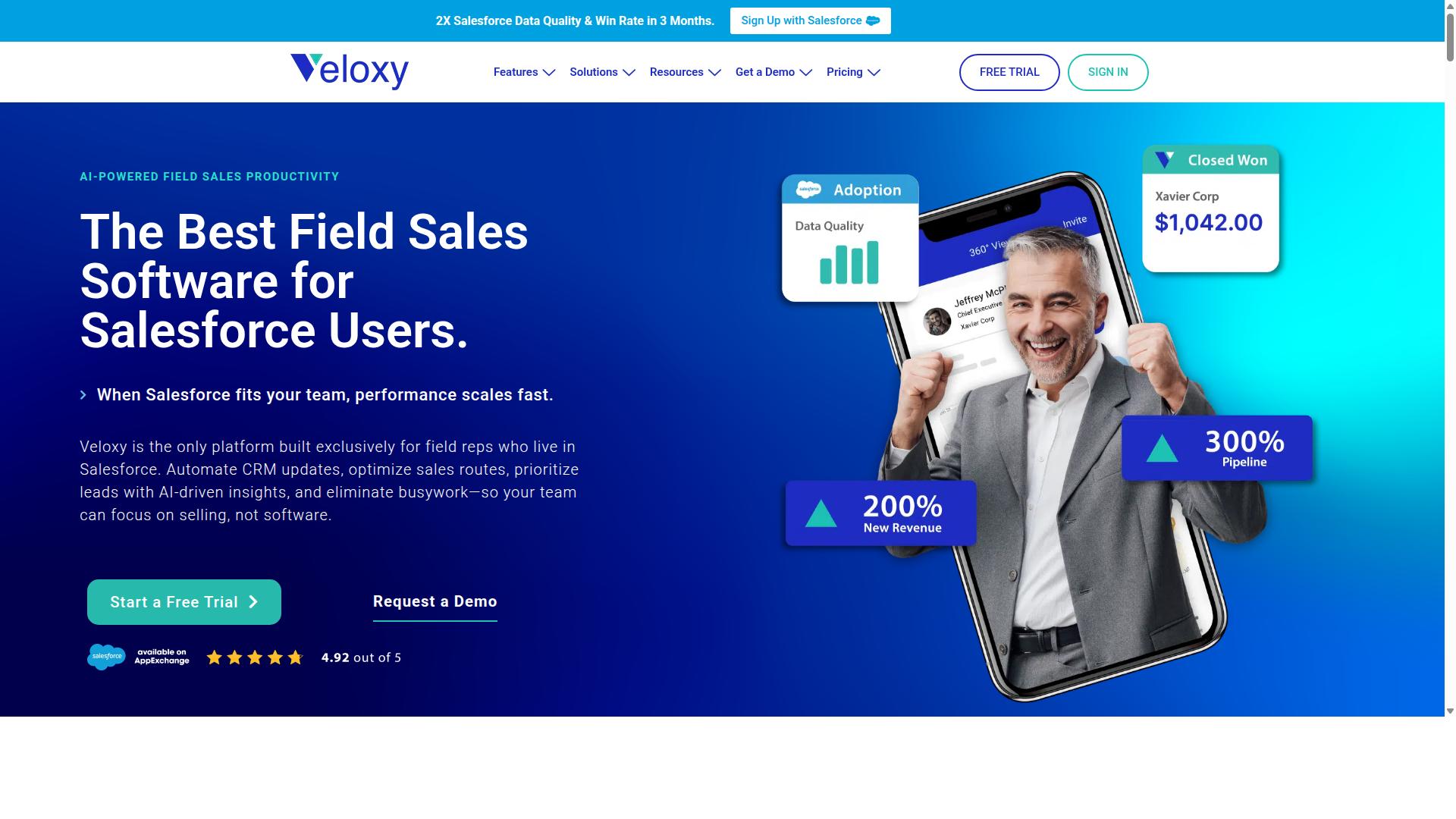
Veloxy stands out as the best overall field sales app for teams already invested in Salesforce, offering deep integration and AI-driven insights that boost rep productivity. It is built exclusively for field reps who live in Salesforce, which means no awkward syncing gaps and no duplicate data entry. Your CRM becomes the single source of truth for every visit, call, and follow-up.
The platform is a full-featured field sales app that covers the entire workflow. Core features include Salesforce Automation, Buying Signals, Lead Qualification, Pipeline Management, Sales Analytics, Quick Dialer, and Guided Selling. That combination supports everything from prospecting to closing, all from a mobile-first interface available on iPhone and Android.
Its AI capabilities focus on predictive forecasting and time-saving. The system processes your pipeline data to surface buying signals and qualify leads before you invest time in them. This approach helps reps prioritize accounts that are most likely to convert, improving sales rep productivity without adding manual work.
Beyond the core toolkit, Veloxy includes practical field tools like Proximity Search, Route Planning, Opportunity Map, and Prospecting Map. These features support territory mapping and sales route planning so reps can group visits logically. A Quick Dialer and Salesforce Caller ID streamline customer contact, while Task Lists That Adapt to the Day help you adjust on the fly.
For teams focused on territory management, the app provides a Salesforce 360 degrees View of every account. You can see contact history, open opportunities, and recent activity in one place. Sales Collaboration tools and Call Blitzes make it easy to coordinate with remote team members during busy selling days.
Veloxy is available on the Salesforce AppExchange, Microsoft AppSource, Google Chrome Web Store, Google Play, and Apple App Store. Pricing is competitive for the depth of features offered, and a 14-day free trial lets your team test the workflow before committing. The unique selling point is measurable: users report doubled sales productivity after three months of consistent use.
For field sales software that respects your existing CRM investment, Veloxy delivers the strongest balance of automation, analytics, and mobile usability. It turns territory coverage from a guessing game into a guided, data-backed process.
2. SPOTIO
SPOTIO is a dedicated field sales app that focuses on territory mapping, lead tracking, and visit reporting, making it a strong contender for teams without a heavy CRM dependency. It is designed for door-to-door and outside B2B reps who spend their days on the road, with a starting price of $39 per user per month and a G2 rating of 4.5. The platform is frequently listed among top field sales CRMs for 2026, evaluated on territory mapping, route optimization, mobile workflow, and pricing transparency.
Its core strength lies in intuitive territory mapping. Reps can color-code their sales territories, drop pins for leads, and see their entire coverage area at a glance. This visual approach to sales territory planning helps managers assign accounts fairly and helps reps understand exactly where they need to be each day. The mobile-first UX is built for reps who live "in the truck," so the interface prioritizes speed and simplicity over complex desktop functionality.
For lead management, SPOTIO keeps things straightforward. Reps can log prospects, track their status, and attach notes or photos from the field. This simplicity is a double-edged sword: it is easy for new hires to learn, but teams that need deep sales pipeline stages or complex qualification workflows may find the options limited compared to full-scale CRM platforms.
Visit reporting is another area where SPOTIO shines. The app automatically records when a rep arrives at a location, how long they stay, and what activities they complete. Managers get a clear picture of field team coordination and sales rep productivity without chasing reps for manual updates. This data feeds into sales performance tracking, helping leaders identify which territories are underperforming and which reps need coaching.
GPS tracking and geofencing are baked into the mobile experience. When a rep crosses into a defined boundary, the app can trigger a check-in or log the visit automatically. This feature is particularly useful for route-heavy teams that need proof of attendance or want to reduce windshield time. It also supports sales route planning by showing the most efficient way to cover a set of pins for the day.
SPOTIO integrates with major CRMs, including Salesforce and HubSpot, so visit data can flow back to the central system. However, it may not be as deeply embedded as Salesforce-native tools. Some teams report that the integration works well for basic sync but lacks the granular customization that a fully native field sales module offers. If your organization relies heavily on complex CRM automation or custom objects, you may need to build workarounds.
One notable limitation is the steeper learning curve for complex analytics. While basic reports are easy to generate, building custom dashboards or analyzing territory profitability across multiple dimensions can take time to master. Teams that want advanced sales analytics out of the box may need to export data to another tool or invest in training.
Overall, SPOTIO is a solid choice for field sales software when the primary job is territory mapping, lead management, and visit reporting. It is less ideal for organizations that need a fully integrated sales force automation platform where the CRM is the single source of truth for every workflow. For teams that value speed and visual clarity over deep customization, however, it remains a credible and popular option in the field sales category.
3. SalesRabbit
SalesRabbit excels in territory mapping and lead management, offering a mobile-first platform that helps field reps cover more ground efficiently. The platform is built specifically for door-to-door sales and event-based selling, making it a strong option for industries like roofing, solar, telecom, and home services.
Its territory mapping tools allow managers to assign specific areas to individual reps, reducing overlap and ensuring complete coverage. Sales territory planning happens visually on a map, which makes it easier to spot gaps in coverage and adjust assignments in real time. The lead management features let reps capture prospects on the spot, log details, and track follow-ups without leaving the field.
Route optimization is another core strength. SalesRabbit helps reps sequence their stops logically, cutting down on driving time and increasing the number of conversations they can have in a day. For teams that rely on canvassing, this kind of sales route planning can meaningfully boost sales rep productivity.
Gamification is a standout element of the platform. Reps can see leaderboards, earn badges, and track their performance against teammates, which can drive friendly competition and keep motivation high during long days in the field. This focus on engagement makes it appealing for sales managers who want to sustain energy across a distributed team.
The app also supports offline access, which is critical for reps working in areas with poor cellular coverage. Field reps can continue logging visits, capturing leads, and updating their pipeline while disconnected, and the app syncs automatically once a connection is restored. This real-time data sync ensures managers see accurate activity without requiring reps to double-enter information later.
SalesRabbit offers CRM integration options, though the depth of integration depends on the plan and the systems involved. Teams already using a major customer relationship management platform should confirm that their specific setup is supported before committing. For organizations without a heavy CRM dependency, SalesRabbit can function as a standalone field sales software solution.
Pricing is transparent at the team level. The SalesRabbit Team plan runs at $59 per user per month billed monthly, while the Pro plan costs $75 per user per month billed monthly or $49 per user per month billed annually. Enterprise pricing is custom, and add-ons like DataGrid AI, Mover Leads, Digital Contracts, and Weather are available at additional cost.
Pros:
- Strong territory mapping and visual assignment tools
- Gamification features that boost rep engagement
- Offline functionality with automatic syncing
- Purpose-built for door-to-door and event-based selling
Cons:
- Pricing can climb quickly with add-ons and higher tiers
- CRM integration depth varies and may require verification
- Less suited for inside sales or purely remote teams
Compared to broader field sales platforms, SalesRabbit is more specialized. It prioritizes the specific workflow of canvassing and territory coverage over general-purpose account management. Teams that live on the street, not in the office, will likely find its approach to territory mapping and lead capture more practical than a generic sales force automation tool.
4. Map My Customers
Map My Customers is a route optimization and territory mapping tool that helps sales reps plan efficient daily routes and maximize customer visits. It is purpose-built for B2B outside sales teams that need to cover large geographic areas without wasting time on the road.
The platform's core strength lies in its route optimization capabilities. It considers multiple factors when building daily schedules, including traffic patterns, appointment windows, and the sequence of stops. This approach helps reps minimize driving time and fit more customer meetings into a single day.
For territory management, Map My Customers offers visual mapping tools that let managers create color-coded zones. This makes it easy to see which areas are covered, which reps handle which accounts, and where gaps in territory coverage exist. The visual layout simplifies sales territory planning compared to spreadsheet-based methods.
The mobile app is designed for field use, and it provides offline access to maps and customer data. This is a practical advantage for reps who travel through areas with poor cellular connectivity. Users can still view their routes, log visits, and capture notes before syncing data once they regain a signal.
Map My Customers provides native two-way CRM integration with popular systems like Salesforce, HubSpot, Zoho, and Dynamics. While this sync is valuable, the tool also functions well as a standalone application for teams that do not rely heavily on a CRM.
Its strengths include a user-friendly interface and a short learning curve, making it accessible for reps who are not technically inclined. On the downside, its analytics and reporting features are more limited than some competitors. Teams that need deep sales performance tracking or territory profitability insights may find the reporting layer too basic.
Map My Customers also includes AI-driven features such as Smart Planner and an AI Field Agent, which assist with scheduling and daily task management. It is best suited for B2B field sales teams that prioritize route efficiency and clear territory visualization over advanced data analysis.
5. BreezeFSM
BreezeFSM offers a comprehensive field service management solution that goes beyond sales, making it ideal for teams that also handle service visits. It is built for B2B companies in sectors like FMCG, Pharma, Manufacturing, and Distribution, where the line between selling and servicing often blurs.
Beyond typical field sales software, BreezeFSM includes work order management, scheduling, and dispatch tools. This broader scope means a single platform can coordinate a technician's repair visit and a rep's follow-up sales call, which is a major advantage for field team coordination.
For territory management specifically, the platform supports journey planning and beat optimization. It also provides live GPS tracking, which gives managers a clear view of territory coverage and helps ensure reps are sticking to their planned routes.
Visit reporting is a core strength here. The system logs outlet and activity management, capturing what happened during each stop. When paired with real-time data sync and offline mode, this ensures that visit data is recorded accurately even in areas with poor connectivity, a common hurdle for mobile sales teams.
BreezeFSM also handles order booking and payment collection directly in the app. This makes it a practical choice for sales reps who need to close deals on the spot, but it also means the tool is deeply tied to transaction execution rather than just pipeline management.
Its analytics dashboards are oriented toward operational metrics like stock levels, distributor management, and field attendance. This is useful for sales performance tracking, but it differs from sales-focused tools that prioritize lead scoring and opportunity velocity.
For pure sales teams, BreezeFSM may feel like overkill. The depth of service management features can add complexity that a dedicated sales team simply does not need. However, for organizations where sales and service operations are integrated, this all-in-one approach reduces the friction of switching between separate systems.
If your primary goal is just territory assignment and visit reporting, a dedicated field sales app might be simpler. But if you need to unify service schedules with sales routes, BreezeFSM offers a credible path forward.
6. RepMove
RepMove is a mobile field sales app that focuses on territory management and route optimization, with a strong emphasis on GPS tracking and performance analytics. The platform is designed for outside sales teams that need a straightforward way to organize daily activities without wading through complex enterprise software.
Its core strengths lie in territory management and sales route planning. Reps can view their assigned accounts on a map, cluster visits by proximity, and build efficient daily itineraries that minimize driving time. The built-in GPS tracking gives managers a live view of field activity, which supports better territory coverage and field team coordination.
RepMove also includes a field sales CRM with sales pipeline tracking and voice-to-text note taking. This makes it easy to log visit outcomes and update deal stages while still on the road. For customer scheduling, the app supports visit reporting and appointment setting, so reps can keep their calendars organized around client needs.
Performance tracking is handled through dashboards that show manager-level metrics. These dashboards help supervisors monitor rep activity, visit counts, and route adherence without needing to manually compile reports. The interface is clean, and the mobile apps for iOS and Android work well for reps who live in their vehicles.
On integrations, RepMove connects with thousands of platforms through its API and native connectors. This includes common CRM integration options, though the depth of sync varies by the system you use. For teams that rely on a specific sales force automation tool, it is worth confirming the exact integration capabilities before committing.
RepMove is best suited for small to mid-sized teams that want a simple, functional tool without a steep learning curve. The simplicity is its biggest advantage; new users can get up to speed quickly, and daily workflows feel intuitive.
However, the platform has some limitations in advanced analytics. Teams that need deep territory profitability reports, complex sales quota modeling, or granular geofencing rules may find the reporting layer too basic. RepMove also offers a 7-day free trial with no credit card required, which is a practical way to test its fit for your sales territory planning needs.
How to Choose the Right Option
Choosing the right field sales app depends on your team's size, CRM ecosystem, and specific territory management needs-here's a framework to guide your decision.
Start by assessing your current CRM. If you're a Salesforce shop, prioritize apps with native integration. Veloxy is designed specifically for field sales, inside sales, and sales management teams using Salesforce CRM, which means it fits directly into your existing workflow without complex middleware or manual data syncing.
Next, evaluate your team size. Small teams often prefer simpler tools that are easy to adopt, while larger organizations need stronger sales analytics and territory coverage reporting. Veloxy serves any sized field sales team, from a handful of reps to enterprise deployments, so it scales with your headcount.
Consider what matters most to your daily operations: route optimization versus territory mapping. Some apps excel at planning efficient driving paths, while others focus on visualizing sales territories and quota allocation. Sales territory planning and territory assignment are core functions for teams managing multiple regions, so decide which capability drives more of your rep productivity.
Budget is another key factor. Field sales software typically ranges from per-user monthly subscriptions to custom enterprise contracts. Match the pricing tier to the features you will actually use, rather than paying for analytics or GPS tracking modules that your team rarely opens.
Think about the daily realities of your reps. Do they need offline access for remote areas? Is customer visit scheduling a bottleneck? Teams that prioritize field team coordination should look for mobile sales apps with visit reporting and geofencing, while teams focused on pipeline growth may value lead management and real-time data sync more heavily.
Here is a quick summary of how to match your needs to the options reviewed:
- Salesforce-centric teams: Choose Veloxy for native CRM integration and a tool built around your existing customer relationship management data.
- Large teams with complex regions: Prioritize apps with advanced sales performance tracking and territory profitability insights.
- Smaller teams getting started: Look for straightforward sales route planning and account management features that do not require heavy configuration.
- Reps in the field all day: Emphasize mobile-first design, GPS tracking, and offline access over back-office reporting depth.
Finally, test the user experience. A field sales app only delivers value if your reps actually use it daily. Request demos, run a pilot with a few salespeople, and ask about onboarding time. The best territory management solution is the one that fits your sales force automation strategy, not just the one with the longest feature list.
Final Verdict
In the final analysis, Veloxy emerges as the top choice for Salesforce users, but the best app ultimately depends on your team's unique workflow and priorities. The right field sales app should reduce friction, not add another layer of manual data entry. For teams already living inside Salesforce, the decision becomes much clearer.
Veloxy is the #1 Field Sales Software for Reps & Managers using Salesforce. It is the only platform built exclusively for field reps who live in Salesforce. After 3 months, Veloxy customers double their sales productivity, pay for their annual Salesforce, and double pipeline and revenue. That is a concrete outcome, not a vague promise.
The productivity shift is striking. Veloxy users spend 90 to 95% of their time on activities that produce sales. Before Veloxy, that number was only 30 to 35%. When your team spends more time selling and less time on admin, territory management improves naturally.
Veloxy holds strong third-party validation. G2 rates it as the Highest Performer with Enterprise Reviews at 4.86, Mid-Market Reviews at 4.71, and Small Biz Reviews at 4.76. The platform also carries 190+ reviews on Capterra and 200+ reviews on Salesforce AppExchange. Top software review sites recommend Veloxy, and G2 recognized it for Best Relationship.
For non-Salesforce teams, tools like SPOTIO or Map My Customers may be a better fit. These options often serve teams that want a standalone mobile sales app without deep CRM integration. If your team does not rely on Salesforce, your priority should be territory mapping, route optimization, and GPS tracking that works independently.
If you live in Salesforce, Veloxy is the best overall choice. The guarantee is simple: no other field sales app on the market offers as many critical features as Veloxy at this price. As Sales AI Pioneers, the platform brings intelligent automation to territory coverage and customer visit scheduling.
To see the difference for yourself, try Veloxy's free trial. You can also reach out directly to explore how it fits your sales territory planning needs. The data speaks clearly, and your Salesforce team can start working smarter today.
Recommended Resources: