
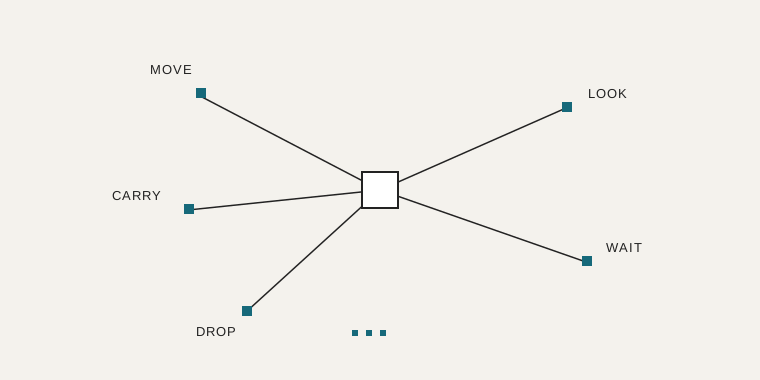
Reading a game by its verbs
The quickest way into a game you are trying to understand is to stop describing what it is about and start listing what it lets you do. Not the themes, not the setting, not the number of hours: the verbs. Move. Push. Wait. Trade. Discard. Look. The list is normally shorter than you expect, and once it is written down most of the arguments you were about to have with yourself resolve on their own.
This is not a clever trick. It is the closest thing game writing has to reading a poem aloud. A game is a machine for producing situations, and the verbs are the machine's moving parts. Everything else — art, music, story, difficulty settings — is either feeding those parts or dressing them.
Make the list badly first
Play for twenty minutes with a notebook open and write down every distinct thing you did. Do not organise it. You will end up with a mess: walk, run, run into a wall, open a door, open a chest, read a sign. That mess is useful, because the second pass is where the real work happens.
On the second pass, collapse anything the game treats identically. If opening a door and opening a chest both mean pressing the same button next to a highlighted object, you have one verb, interact, not two. If running is walking with a held modifier and no other consequence, you have one verb with a dial on it. Keep collapsing until every entry on the list produces a different kind of situation. Most games settle somewhere between three and eight verbs. A great many settle at four.
Then ask what each verb costs
A verb with no cost is barely a verb; it is a formality. Jumping in a platformer costs you your footing and a moment of committed trajectory, which is why it can carry an entire game. Jumping in a game where you cannot fall and nothing moves costs nothing, and it will never be interesting no matter how good it feels in the hand.
So next to each verb write the cost: time, position, a resource, information given away to an opponent, a door closed behind you. If several verbs share a single cost — if everything you can do spends the same pool — you have found the game's actual subject, and you can usually predict what its best moments will feel like before you reach them.
Look for the verb the game withholds
The most telling entry is frequently the one that is missing. A game about exploration that will not let you mark the map is making a claim about memory. A game about conversation with no verb for silence has decided that talking is always available, which is a design position whether or not anyone in the credits thought of it that way. Withheld verbs are where designers do their strongest work and take their least credit.
Notice too when a verb arrives late. Handing the player a new action three hours in is a structural decision equivalent to a key change. It re-reads everything before it. When people say a game “opens up”, they generally mean a verb arrived, not that the world got bigger.
A worked pass
Take an ordinary stealth level. The rough list is: move, crouch, look, wait, distract, strike. Collapse it: crouching is move with a speed and noise dial, so it folds in. Looking, in most such games, is free and continuous, so it is a condition rather than a verb. That leaves move, wait, distract, strike. Now the costs: moving spends position and makes noise; waiting spends time, which is the only thing the patrolling guard also spends; distracting spends a limited item and, crucially, information, since it tells the room something happened; striking spends the ability to remain unnoticed.
Four verbs, and already the shape of the level is legible. Waiting is the only action that costs nothing but time, so a level that never rewards waiting is fighting its own machine. Distraction is the only verb that moves someone else, so it is the level designer's main instrument. Strike ends a thread permanently, so its real function is to convert a spatial problem into a timer. None of this required an opinion about the game's quality, and all of it is now available for one.
Where the method runs out
Verb lists are poor at describing feel. Two games can share a verb list and be nothing alike because one of them gives the input eight frames of weight and the other gives it none. They are also poor at open-ended toys, where the interesting behaviour comes from the simulation's reactions rather than the player's inputs; there the equivalent exercise is listing what the world does on its own while you stand still.
But as a first move it is hard to beat. It forces description before judgement, it is cheap, and it produces a written artefact that another person can argue with. If you want one habit for writing about games, this is the one to take.