
Notes on difficulty
Arguments about difficulty are unusually unproductive, and the reason is that the word is doing at least four jobs. Once the jobs are separated, most of the disagreements turn out to be about which one matters, which is a real question rather than a shouting match.
Execution
Execution difficulty asks whether you can perform an action you already understand. Hitting the timing, holding the line, clearing the gap. It responds to practice in a fairly linear way and it is the only one of the four that is genuinely a physical skill.
Its virtue is that progress is legible: you can feel yourself getting better within a single session. Its risk is that it excludes on grounds unrelated to the rest of the design. A puzzle whose solution requires a fast input has quietly become two tests, and only one of them was the point.
Comprehension
Comprehension difficulty asks whether you understand what is happening. This is the difficulty of a strategy game's opening, of a system whose feedback is indirect, of any design that declines to explain itself.
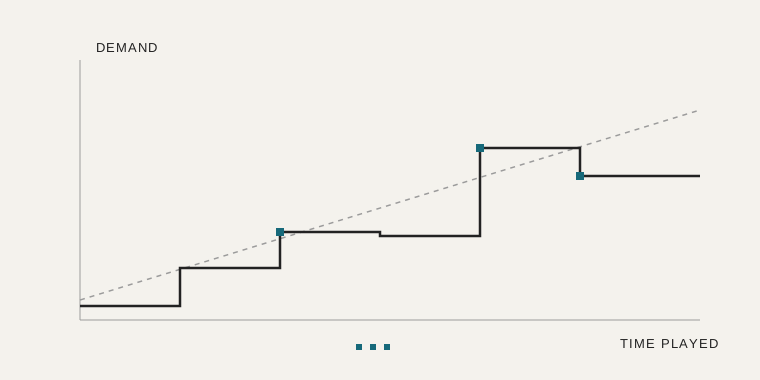
It behaves nothing like execution. It does not respond to practice smoothly; it sits flat and then collapses, because understanding arrives all at once. Designs that trade in comprehension difficulty therefore have a characteristic shape: a hard, slightly unpleasant beginning followed by a sudden opening out. Judging them by their first hour is a category error, and so is defending an incoherent first hour by appealing to this pattern.
Planning
Planning difficulty asks whether you can find a good line among many. It is the difficulty of a deep board game, of a well-built tactics layer, of anything with more legal moves than you can evaluate.
It is the most durable kind, because it does not exhaust: a position can remain hard after a hundred plays. It is also the least amenable to a difficulty slider, since lowering it usually means removing options, which removes the game rather than easing it.
Endurance
Endurance difficulty asks whether you can keep doing it. Long stretches without a save, attrition across a run, resource pressure over hours. It is real, it produces some of the strongest memories in the medium, and it is also the one most often mistaken for depth.
The test is simple: if a session were half the length with the same decisions, would anything be lost? Sometimes the answer is yes and the length is doing genuine work, holding tension across a span that a short version could not. Often the answer is no, and the difficulty is a tax rather than a design.
Why the sorting helps
Take the common complaint that a game is “too hard”. If the difficulty is executional, an assist that slows the input preserves everything else the design was doing. If it is comprehension, an assist is close to useless and a better tutorial is the actual fix. If it is planning, an assist that suggests moves does not lower the difficulty, it removes the activity. If it is endurance, a shorter session length is the honest lever and it costs the design almost nothing except the designer's attachment to scale.
Accessibility work benefits most from the distinction, because it makes clear which adjustments preserve the experience and which replace it. Blanket difficulty options are a poor instrument; four separate dials, most of the time, are the right shape and are what thoughtful projects converge on.
One position, stated plainly
Difficulty is not a virtue in itself, and neither is its absence. It is a way of making the player's attention expensive, so that whatever the design does next is paid for. The question to ask of any hard section is what the expense bought. If the answer is a real change in how the following material reads, the difficulty is doing work. If the answer is that the section is longer, it is not.